
In 1798 Silversmith Paul Revere recollected about his famous ride. He was a member of what they called “the mechanics.” There were about 30 of them who formed a committee for watching the movements of the British soldiers. “The mechanics” was probably not a committee name, but the social class of the members.
In Henry Wadsworth Longfellow’s famous poem he stated that Revere yelled that “the British are coming.” That probably did not happen because they needed to ride as quietly as possible to not be stopped and detained by British troops.
Instead, 11 days before his famous ride, Revere went to Concord to warn the Massachusetts Provincial Congress of possible troop movements of the British army, then referred as the Regulars.
On the evening of April 18, 1775, Dr. Joseph Warren summoned Paul Revere and gave him the task of riding to Lexington, Massachusetts with news that British soldiers were about to march into the countryside northwest of the town. The troops planned to arrest Samuel Adams and John Hancock, two leaders of the Sons of Liberty. It was thought that the British would continue to Concord to capture or destroy supplies of gunpowder, ammunition, and several cannons that were stockpiled there. It turns out that Dr. Warren’s intelligence was faulty.
Revere contacted an unidentified friend and instructed him to hold two lit lanterns in the tower of Christ church as a signal to fellow Sons of Liberty in case Revere was unable to leave town.
Revere went to Boston’s North End waterfront. There two friends rowed him across the river to Charlestown, slipping past the British warship HMS Somerset. Revere landed safely. About 11 PM Revere set off on horseback. Just narrowly avoiding capture outside of Charlestown, Revere changed his planned route and rode through Medford, where he met Osaac Royall, and arrived in Lexington after midnight.
As Revere approached the house where Adams and Hancock were staying, Sergeant Monroe, the guard outside asked Revere not to make so much noise. Revere insisted that “you’ll have noise enough before long. The regulars are coming out!”John Hancock heard him and invited him in saying “Come in, Revere! We’re not afraid of you.” Revere entered the house and delivered his message.
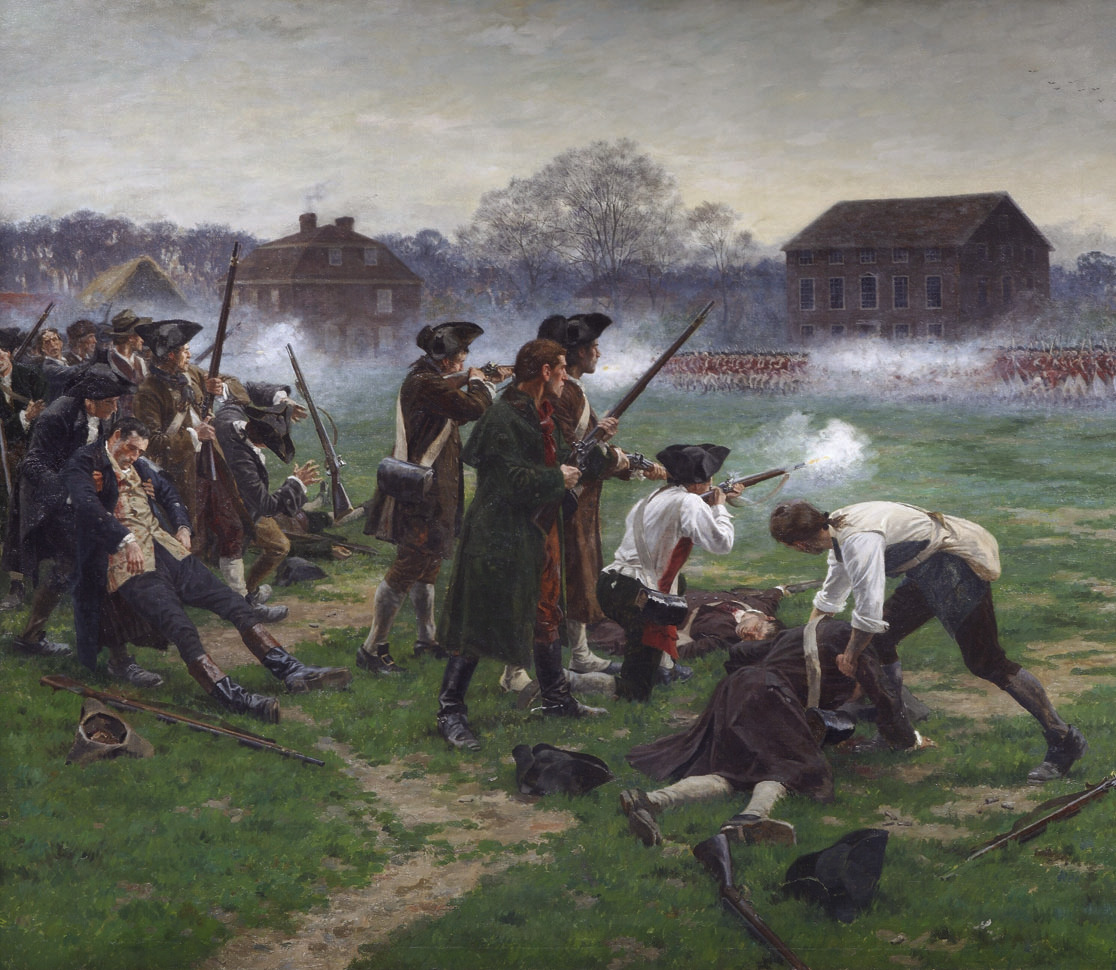
About half past midnight, William Dawes, who had traveled the longer route out of Boston, arrived in Lexington carrying the same message. After a rest, both headed to Concord to verify that the Concord armaments were properly hidden away. A short distance out of Lexington, they were overtaken by Dr. Samuel Prescott who was a Son of Liberty. Shortly after that, a British Patrol intercepted all three men. Prescott and Dawes escaped, Revere was held for some time, questioned and then let go. Before his release, his horse was confiscated and the British rode off to warn the approaching army column. Revere was left alone on the road. Meanwhile, local militiamen emerged from Buckman Tavern, the area’s busiest local tavern. The men formed two rows on the common to face arriving British troops.
Revere returned on foot to Lexington just in time to witness the Battle on Lexington Green. At sunrise on April 19, the battle unfolded, Revere helped Hancock and his family escape Lexington and carried a trunk of Hancock’s papers. Eight Lexington militiamen were killed and ten wounded. These were the first causalities of the American Revolution.
(paulreverehouse.com)