
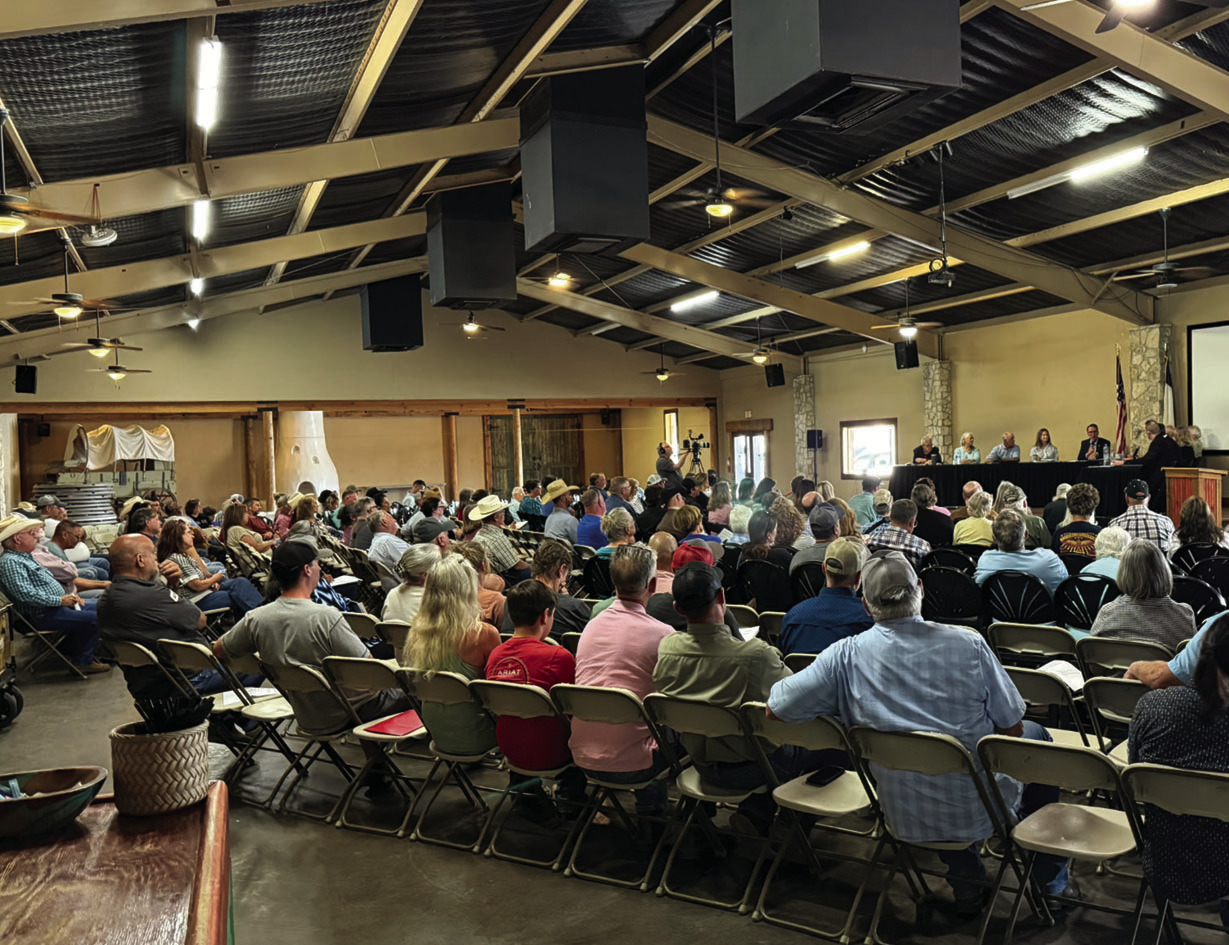
Hundreds of citizens from Erath, Somervell and surrounding areas attended a meeting with Oncor representatives regarding the proposed Dinosaur-Longshore Switch 765KV transmission line project.
The meeting was held Wednesday, May 27 at City Limits in Stephenville and featured members of the Erath-Somervell Sub-Regional Planning Commission (Chapter 391). Individuals in attendance included: Erath County Judge Brandon Huckabee, Somervell County Judge Danny Chambers, Erath County Commissioner Dee Stephens, Somervell County Commissioner Jeff Harris, Erath County land owner Joanna Friebele, Stephenville City Councilmember Gerald Cook, Somervell County citizen Vicki Hoggete, American Stewards of Liberty Margaret Byfield and Oncor representatives Thomas Yamin and Jaren Taylor.
The format of the meeting was question and answer from the board and selected citizens to the Oncor representatives. Specific topics included agriculture (specifically dairy), the process of notifying citizens and the safety of the lines in regards to first responders.
So far on the project, Oncor has identified proposed routes, sent out notices to those within 500 feet of those routes and started the process for protests, intervention and testimony.
The Public Utility Commission is set to choose a final route in mid-August.
The discussion began with environmental impacts not addressed on the assessment process resolution.
Judge Huckabee said in full disclosure Oncor representative Taylor has met with him before on the communication tower project and the concerns the county has with that issue.
The judge asked Oncor if there had been any study on the 765KV lines and the impact to the kind of communications project that Erath County has ongoing.
“Erath County just joined, along with the city of Stephenville, the entirety of Erath County including the volunteer fire departments, city of Dublin, Somervell County and Hood County on a communications project,” Huckabee said. Erath County’s portion of it is $8 million. “It’s about to go live, and a big concern is interference with towers, placements of sites etc. because we did our engineering before this.”
Oncor representative Taylor opened his answer by first thanking everyone for having them and said they would attempt to answer all questions presented to them, and if they did not have an answer, they would find it and get those back to the county.
Taylor said the communications issues were addressed at the hearing on the merits which occurred in Austin a few weeks ago and that Oncor’s engineering team had looked at the information the county provided on the project.
“If I remember correctly these are microwave based towers and that is the same technology commonly based for substations to communicate. We don’t anticipate any issue with those communications,” Taylor said.
Taylor said that they have looked at it as much as they could before a route is chosen and individual structure sightings occur. He said coordination with the county is pretty common.
“It is a goal that we would communicate with the subregional planning group on those types of issues when the time comes,” Taylor said.
Judge Huckabee questioned what the mitigation process look like if they got through this process and there were issues in regards to communications?
“Frankly we are responsible for operating and maintaining the transmission system, and doing it with as little impact as we can,” Taylor said. “I personally don’t know what the remediation efforts would be. The first step is to locate the towers and locations where we avoid interference from the get go.”
Taylor said if interference was to occur there are several methods Oncor engineering can get into to try to address it.
Oncor representative Thomas Yamin added that Oncor has had projects (though not 765kv ones) with communication towers in the proximity and they have not experienced any issues.
Cindy Shipman who works with the Erath County Historical Commission addressed several issues including cemetery and burials.
When residents began to get notices about the project potentially going through their land, and potentially being close to family cemeteries, Shipman said she began doing research on how to help.
“I began using the Oncor interactivemap.Haveyouused that map?” she questioned the representatives. Thomas affirmed that he had used it.
One of the difficult aspects of using the map, she said, was having to use a street address or an Oncor plot number, even though it’s essentially the county’s appraisal map.
Shipman said there are about 150 known burial sites in the county, and about 70 of them are given addresses and locations on the Texas Historical Commission Atlas.
“We want to protect those,” she said. “Have you been to many cemeteries that have street addresses?”
Oncor identified eight cemeteries that were in danger, she said, when she identified 17. Notification parameters for cemeteries are 1,000 feet and Shipman said it was an issue because many cemeteries have become abandoned. On those, even the appraisal district reportedly didn’t have addresses for contact.
“What’s the protocol for protecting those sites?” she said.
“So, the notices that go out are based on the PUC rule, and that rule is based on the appraisal district data. The protocol is that which is laid out in the PUC substantive rule on the notice for licensing proceedings,” Taylor said.
“Some received notification and some didn’t. How are we suppose to notify people here locally if we don’t know who owns the property?” Shipman said.
Taylor addressed notices going out and said a public notice was published in 18 different newspapers (including The Dublin Citizen) throughout the study area.
“So I think that’s the way the Public Utility Commission tries to cast a wide net recognizing at times property records may not have every single individual who is interested in the project,” he said. Taylor said the notices were found to be sufficient and complied with at the hearing from last week.
Huckabee added that while he was grateful for the interactive map, it was extremely outdated. The judge asked what year the map was? Taylor said while he was not 100% certain, he believed it was 2024.
“The length of the study area is 300 miles. While we could get more up-todate aerial maps for certain counties, and certain areas, we had to use the same aerial for the entire thing, which required us to use an older aerial,” Taylor said. Yamin added that Oncor doesn’t just use aerials but also such tools like Google Earth because ground truth cannot be done on private property until a route is chosen by the PUC.
Taylor said they received some information from counties when they reached out.
Judge Huckabee said he was provided an email (that he does not remember receiving and was later given in printed form ) dated Dec. 10, 2024 from Kimley-Horn first alerting him to the project. Taylor clarified there would also be physical letters that would have gone out along with additional emails.
“It requested information regarding environmental, land use and other items of interest. ‘Your comments will be an important part of assessment and potential impacts,’” Judge Huckabee said.
The deadline to respond was Dec. 31 (or 21 days from when it was sent).
Huckabee asked if Oncor representatives believed that was enough time to gather the amount of information for a project of this size.
“So typically, that information is going to be files that the county already has available to it, so yes I would hope that is enough time,” Taylor said. “We continue to receive information from counties and other municipalities across the study area for months and months after. That’s one of the reasons we delayed the filing of this application was due to quantity of the data that came in.”
American Stewards of Liberty Margaret Byfield reiterated that they gave the county 21 days for information, had no ground truth, and did not reach out to the cemetery expert in this area.
“What we are hearing is you’re checking off boxes, but not doing diligence,” she said.
“Respectfully, we did do our due diligence and it’s documented in the testimony and evidence that was provided at the hearing on the merit,” Taylor said.
Discussion also addressed training firefighters on responding to disasters near the 765KV lines with Taylor taking back a request to Oncor to provide local first responders with training.
He also said there is protection in place that lines de-energize in seconds in the event of a collapse or an emergency.
KatieMcDowellof Armagh Dairy asked agriculturally related questions stating Erath County did $471 million in agricultural sales last year $289 million in milk sales and $88 million in beef sales.
“Has Oncor conducted any agriculture specific impact assessments related to the 765KV specifically, or any power lines in general?” she asked.
Taylor referred to testimony given and presented at the hearing by Dr. Gilman.
“I don’t know that I would say that there has been a study done of agricultural impact, but what there is 100 years of experience of transmission lines running through agricultural properties,” Taylor said. “I know different dairy farms and cattle operations throughout this state that operate with 345KV transmission lines, I know there is a difference in the voltage there, but those have been in operation for years.”
McDowell also asked about the effects on milk production, the stress of the lines on the animals, RFID ear tag interaction, what herbicide would be used and how Oncor works with certified organic dairies, farms and ranches as well as money for operational losses.
Byfield said that they had done informal calculations based on information that the entire project is 4,000 linear miles and because these towers are so tall it would devalue the property a mile on each side, by 40%.
“Statewide, the very low number we have calculated is that landowners in Texas will lose $10 billion in uncompensated property loss,” she said. “Which means that every land owner in here is facing a 40% reduction in land value if these towers go through.”
Taylor said Oncor is ordered to build the project by the Public Utility Commission after being determined to be necessary by the Texas Legislature. The project is being done because of demand needed by the oil and gas companies in the Permian Basin, as well as to add stability to the grid.
“I understand West Texas needs power, I don’t know why it’s our problem,” Somervell Commissioner Jeff Harris said.
Judge Huckabee towards the end of the meeting said a lot of the process seems backwards, but a lot of that is determined by the Texas Legislature and the PUC.
“It seems like it is a ‘trust us’ situation. ‘Trust us we’re going to pick the route, trust us there is not going to be an environmental impact, trust us there’s not going to be a health impact, trust us there’s not the potential for a water contamination issue.’ That’s a lot of trust to be built into a process that will literally change generations of land that has been in people’s families for generations and effect future generations on a ‘trust us’ situation,” he said. “I completely disagree with the process.”
To hear the entire meeting and comments, go to Erath County’s You Tube page and click on the ‘5-27-2026 ESSRPC MEETING.’