
Because of the number of fires in town, Dublin citizens became interested in a fire department just prior to 1890. They started out with a small hand operated pump Dr. O’Brien bought in Chicago. It had a hose that could be put down a cistern or well for a source of water. (February 10, 1950 Dublin Progress)
W. P Hallmark became interested in the fire department soon after he and his young wife moved to Dublin in 1892. Because some citizens weren’t all that interested in fighting fires, he was soon named Chief of the Dublin Fire Department. (June 12, 1953 Dublin Progress)
In 1898, two larger hand pumps were purchased. Later in 1905, two reel type hose carts and one hook and ladder wagon, all hand drawn, replaced the out dated equipment. The fire losses were reduced because of the more efficient equipment.
The fire department made great strides forward when in 1908 they bought a horse drawn fire wagon. There was a lot of controversy soon after. According to the June 12, 1953 Dublin Progress, “It seems that expending some $1600 dollars for the fire wagon, the city dads figured they had gone as far as they could go in investing money in fire fighting equipment. As a result, a deal was made whereby a local livery stable operator, Eli Powell, agreed to furnish two horses for the department at the rate of $5 per trip. However the city government soon decided that buying its own horses would be a good investment after Powell rendered a bill for his first month’s services -- $100 for 20 calls.”
Chief Hallmark made a deal with a local farmer for two horses for $300. April 1, 1908 the city purchased them. “The two horses, Bud and Barney, seemed born for the job and instinctively knew that speed was necessary for the job. The harness hung from the ceiling of the fire station and was let down so that it fell down on them. The instant the harness touched the horses, they were raring to go. One time, the firemen weren’t on board yet but the horses took off anyway leaving the bewildered men behind. After that, the firemen made sure they were on board first.” (Covered Wagons Keep On Rolling, Westphal,68)
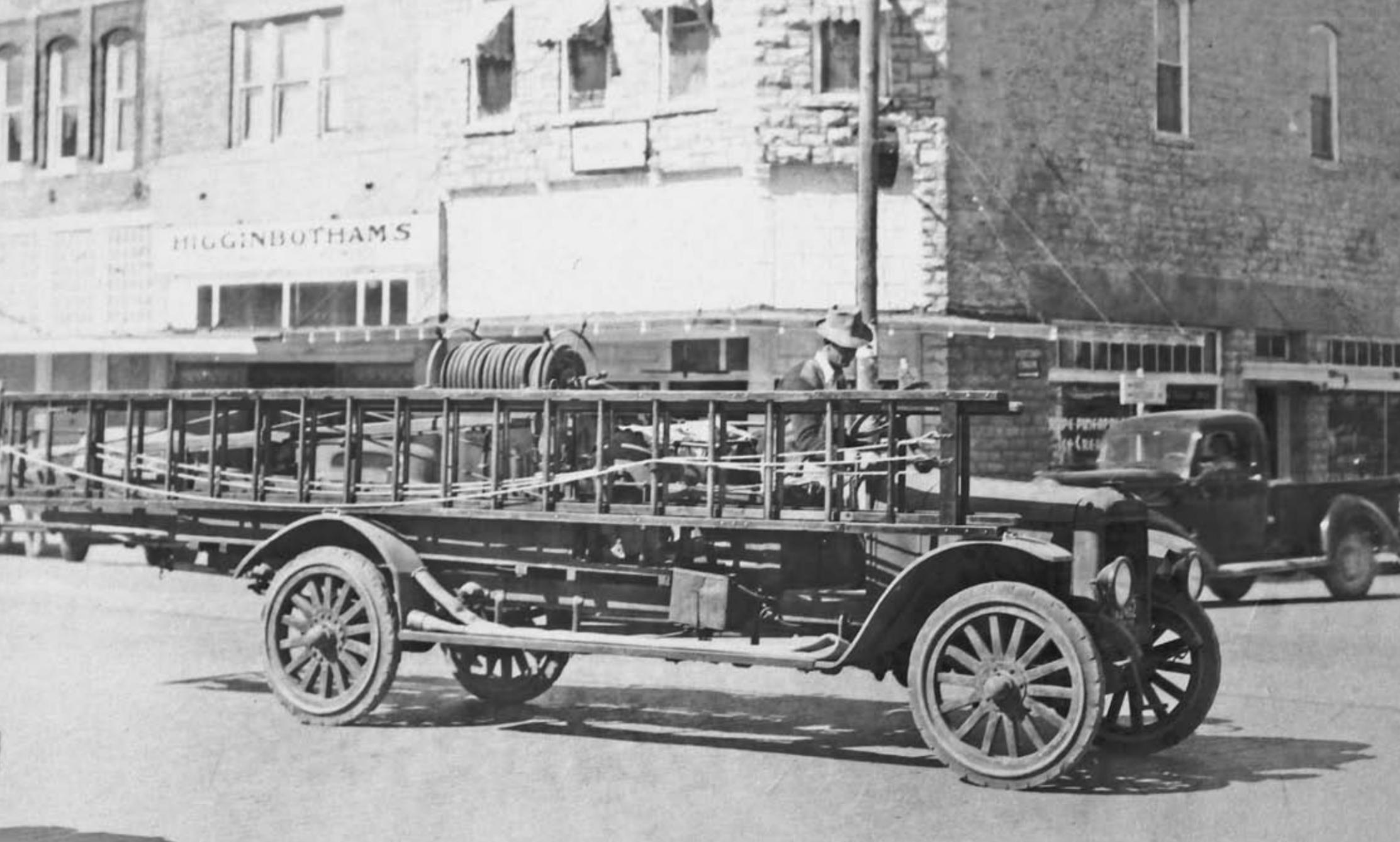
In 1917, Dublin had a huge blaze in a warehouse at the Dublin Oil Mill that had just been converted to processing peanuts. A conveyor belt carried the fire allover the building. The fire burned for a month. Chief Hallmark never left the scene. He was brought food and changes of clothes and slept on the floor. In September of that year, the city auctioned off the horses for they had purchased their first motorized solid tire Republic truck combination hose wagon with ladders and a small booster tank with a peel off one-inch high pressure hose.. (Covered Wagons Keep On Rolling, Westphal, 69).
This 1917 Republic was probably a “Liberty Truck” as they were called, because they were used to move supplies during World War I. It was probably delivered to Dublin as a standard truck and a local blacksmith shop most likely made modifications such as mounting brackets for the ladders and running boards for firemen to ride on.
In 1921 a Ford model T truck was acquired. When it would start and didn’t have a flat tire it carried extra hose to the fires. (June 12, 1953 Dublin Progress)
Later, a 1929 American La France fire engine was purchased. If you want to look, on youtube.com there is a video of Jay Leno’s garage that shows a 1921 American La France engine that is much like the engine that Dublin bought. The owner of that engine said the pistons inside the motor are as big as 2 pound coffee cans and provide plenty of power.
In a conversation with Pat Leatherwood, he said that with the new more powerful engine in the American La France Truck, there were new things to worry about. With each length of hose that extends from the pump, a higher pressure must be engaged so the correct pressure is present at the water nozzle. Also the more powerful pump was capable of collapsing the water mains with suction, so an eye must be kept on the gauges.
As time has passed The Dublin Fire Department has acquired new improved fire fighting equipment and is serving not only Dublin, but much of the surrounding area.