
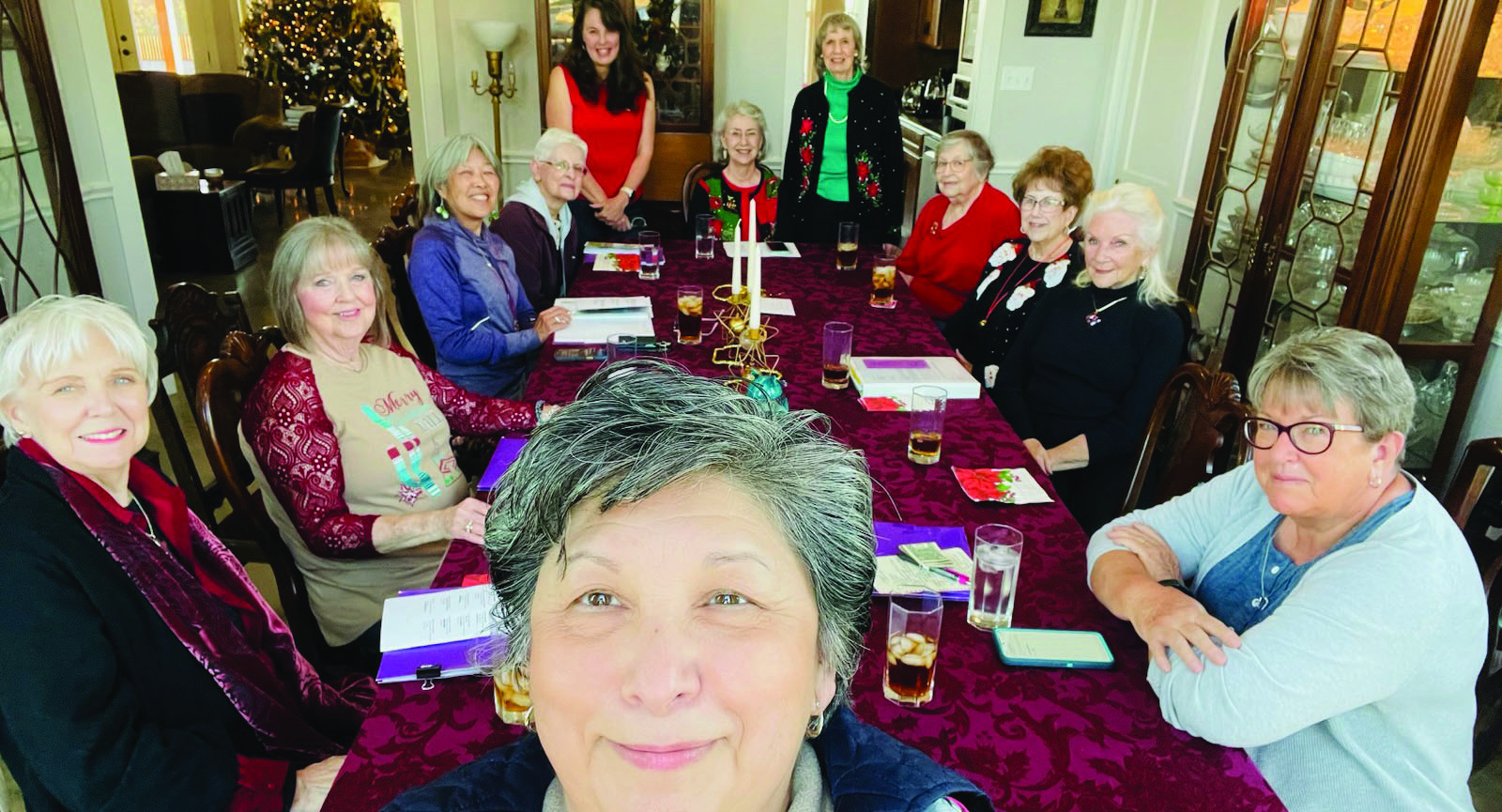
The Woman’s Thursday Club of Dublin met at the beautiful home of Dana and Michael Herod. The meeting was hosted by Mary Howard and Dana Herod, who presented an excellent program on our own Cross Timbers and Prairies Ecoregion. First off, we learned that Texas Parks and Wildlife has removed our ecoregion from 7th Grade science books! They have reconfigured ecoregions around us and put us in with the Blackland Prairies Ecoregion. We find that to be disturbing and inaccurate.
Our ecoregion encompasses an area of 26,000 square miles. It is a mix of bands of knotty hardwoods, mainly Post Oaks, and open prairies. It consists mainly of limestone, which is full of fossils. An acquaintance of Dana’s was mystified that we could have so many sea fossils, as hilly as our area is. He is apparently not familiar with, or not a believer of an event called The Flood.
Spaniards came to our area in the 1600’s, evidenced by the mission they built in Comanche. They brought with them horses, which enticed the Comanche Indians to venture this far south into our area. The flora consisted of tightly arranged oaks, mainly post oaks, which were so dense that settlers could not easily penetrate its ranks. We surmise that because the settlers could not easily cross these timbers, our identity as Cross Timbers was born. Dana’s property still holds an impassable 8 acres of oaks. Her family had always considered this a bane on their existence. However, so much of the oak stands have been obliterated and replaced with stands of Mesquite that likely spread with cattle, that she now recognizes the value of the stand as a testament to the native condition that is so rarely found here anymore.
The original Indian tribes displaced by the Comanche included the Lipan and Havasupai (whose native language ‘invented’ the name for Texas.) “Hannah’s Legacy” is a book which describes the wild horses in this area in 1860’s. Many families in our area have family accounts of the ruthless behavior of the Comanche Indians on their raids to acquire horses. Conversely, they describe the Indians native to our area as peaceable and pleasant.
In the 1840’s, our weather, like now, was typified by erratic rainfall, hence sparse water sources. Settlers gravitated to the creeks in our area, likely originally intending to move to places where the weather is more reliable but were drawn to stay by the beauty of this area. Bell Branch Creek, Greens Creek, Little Fork, and Village Creek are some of the creeks that enticed settlers to stay. Settlers came by foot, wagons, horseback and even steamboats! Likely the Trinity or Brazos could transport folks this far north.
Cast Iron Forest is a nickname for our oak stands and is one of the last remaining virgin North American hardwood forests. Climate data and biodiversity is collected due to its virgin nature. Burrowing Owls and ground squirrels had been prevalent in our area. Fire Ants have all but wiped out many of our ground animals. Efforts have been made to reestablish quail in this area. Snakes, birds and wrong habitat have thwarted these efforts. Judith Lemons was told by Ricky Little that if you grind mistletoe into their anthills with your heel, it drives them away. She did indeed drive it in with her heel in one fell swoop, and lived to tell the tale. It may simply relocate them, but the method appears to work! Sumac is famous for harboring Copperheads. Roadrunners are still present but are fewer in number now. Bears were once prevalent here but have become scarce. Pam Crabtree has seen evidence of porcupines (spines on her dogs’ muzzles) but had not seen them. Armadillos and skunks are still here in abundance. Big cats, notably a large panther Dana’s father had captured, are still in our area.
Our next meeting will be Thursday, Jan. 8, 2026. It will be a business meeting, including election of Officers for the next twoyear period, hosted by the Executive Committee.