
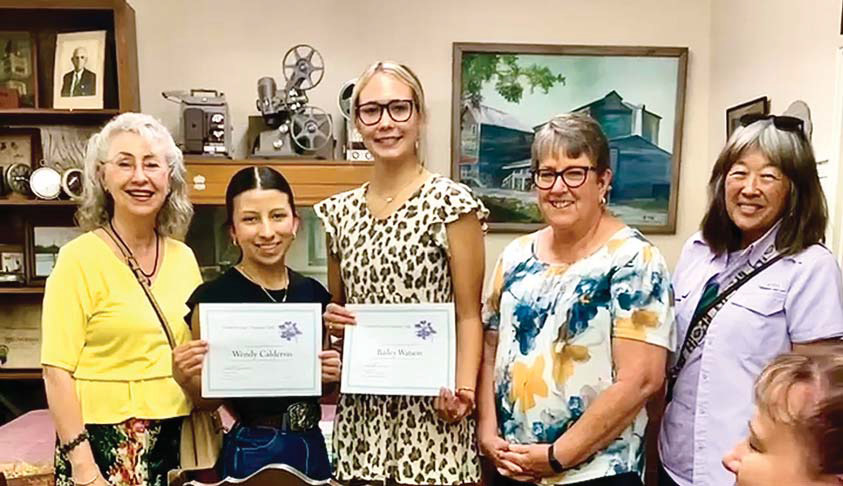
The Dublin Woman’s Thursday Club met at the Dublin Historical Museum for its May 2025 meeting. Our first order of business was to introduce our scholarship recipients.
Typically we only award one scholarship. This year, we have sufficient funds to award an additional scholarship. We voted to approve the award of a second scholarship. Our two recipients are Wendy Calderon and Bailey Watson.
They are excellent students, and they both do so much to support the community in which we live. Their aspirations beyond high school are commendable, and we are happy to help them.
Next, Judy Lunsford presented our next study topic, the Edwards Plateau Ecoregion, a temperate grasslands, savannahs, and shrublands ecoregion in central Texas, that is large enough to be seen from space! It is best known as Hill Country. Some maps of ecoregions make it appear that the Edwards Plains stop well south of Erath County, but one chart lists that Erath County, at least in part, is in this ecoregion. The main boundaries are; the Balcones Fault to the south and east; the Llano Uplift and the Llano Estacado to the north; and the Pecos River and Chihuahuan Desert to the west.
It is one of our prettiest ecoregions. Its well-drained soil ensures rainwater flows into the Edwards Aquifer, a significant aquifer, a recharge zone in the south which feeds rivers to the south, which is important for this habitat which does not see much rain, and has a long growing season.
Itconsistsof trees,savannah, and balsamic sandstone, so caves are numerous, and are home to countless Mexican Freetail Bats, which few can forget if they have seen them emerge in the evening from the bridge in Austin! Some subterranean caves are also home to a species of catfish which have no eyes. The Spiny Lizard also calls this home. Much of the area has been converted to development. Further alteration to the savannah has occurred from the encroachment of shrubs, which controlled burns help manage. Mountain Cedar (technically Ashe Juniper) now dominates this ecoregion.
Earliest human settlement of this area was by Jumano and Coahuiltecan Native Americans. Then the Apacheria extended into the Southern Plains, forerunners of the Lipan and Mescalero Apaches. The Comanche expelled those groups from the Plains, which became dominated by the Penateka band of Southern Comanche. We thank Judy for her fine presentation.
In other business, Patty Hirst reported on the library status. It has lost its main source of funding for the Summer Reading Program with the closure of the D.A.R.E. program.
The library recently hosted a breakfast burrito fundraiser to raise money for the program.