
Ben Pate
It was a difficult time for people all over the United States in 1933. The Great Depression started in 1929 and continued to get worse. Franklin Delano Roosevelt was elected in November 1932. His campaign was all about “The New Deal” a new concept of the government helping people in economic distress. His inauguration took place on March 4, 1933. He had a long list of things he wanted to do to help people in need. One was the Civil Conservation Corp.
FDR signed the presidential orders on March 31, 1933 just weeks after his inauguration to create the CCC. The officers from the United States Army were in charge of the camps. The projects were created by the departments of Agriculture and Interior. The Soil Conservation Service and Texas A&M would plan the work the men would do here in Texas.
In May of 1933, young men just out of high school who couldn’t find a job were sent to military training camps to serve in CCC. They would eventually be sent to one of the 34 CCC camps established here in Texas. Several men from Dublin were sent to those camps. FDRs plans were moving fast. Officials came to Dublin to look the area over. Weeks later it was announced that a CCC camp would be established here in Dublin.
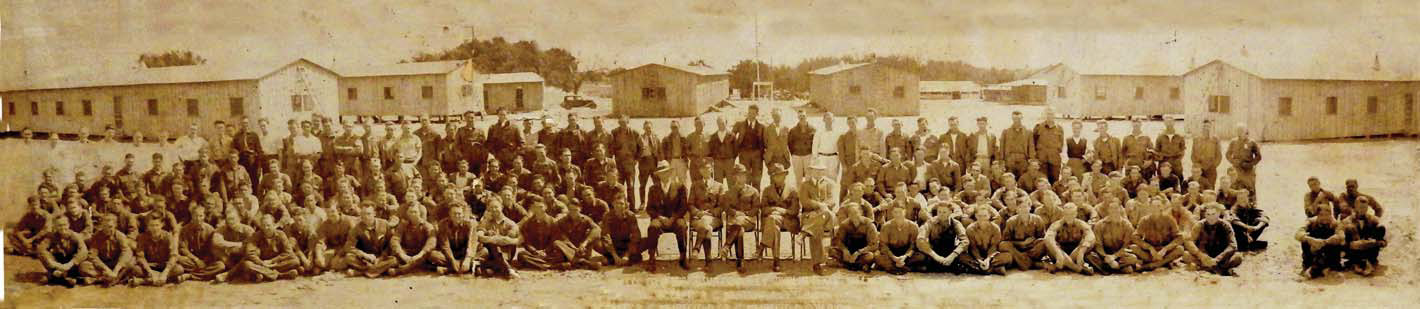
On June 17th, 1933 the “Tree Army”soldiers arrived from Fort Sill, Oklahoma.
They arrived aboard a Frisco train with six passenger coaches at 3:50 AM. Their tools consisting of tents, cots, blankets and rations. They removed their tools from two railroad baggage coaches. At Dublin City Park they wasted no time putting their camp together. They set-up tents and made use of the buildings that were already at the park. Capt. Dibrell and Lt. Babcock were pleased with the work the men were doing. (Dublin Progress, June 23, 1933) The Dublin City Park was chosen because of the location. The city provided pure water on the grounds and electrical service was available. (Dublin Progress, June 9, 1933) While the official designation for the camp is E-67-T, it was decided to name the camp in honor of U.S. Senator Tom Connally of Texas. Camp Connally is identified on the Dublin Sanborn maps of that time. (Dublin Progress, June 30, 1933) John T. McAfee was the administrator of the camp. It was his job to oversee the work the men were carrying out and the orders from the engineer in charge. (Dublin Progress, (Dublin Progress, June 16, 1933) The government would pay young men 18-25 who needed work, to help with projects that would save valuable top soil. The U.S. had learned from the dust bowl that if soil is left unprotected, erosion would create an ecological disaster. Saving the top soil was necessary for farmers to successfully raise crops and cattle. The CCC army worked on terracing the land, cutting trees and underbrush or in some cases would build buildings in parks. In exchange for their work. they were paid $30 dollars a month. $25 would be sent back home to their needy families and the workers would keep five dollars for incidentals. The work program provided most of what they needed, food, clothing, medical care and living space. I am told that all the men would go to the movie theater and sit in the balcony together for Thursday night movies.
When a man signed up for the program, he agreed to serve six months. After that he could re-enlist or get out. Later in the program veterans from World War I were also eligible, normally operating in separate camps. (The Handbook of Texas Online) According to P.H. Walser, College Station, “On the local Greens Creek Project ... more than 350 miles of terraces were constructed on 183 farms. Terracing is only one part of a coordinated program of soil and water conservation.” (Dublin Progress, Friday October 25, 1940) The U. S. Army found the program beneficial too. It enabled officers to work with enlisted men. “Through the CCC, the Regular Army could access the leadership performance of both Regular and Reserve o ff i c e r s.”( Wi k i p e d i a , Civilian Conservation Corps/U.S. Army) In October of 1933, Camp Connally started getting ready for cold weather. Work started on five barracks 20 feet by 120 feet. Each would house 40 men. The cost of the project was $8000. Building Materals and hardware were supplied by Higginbothams for $5100. (Dublin Progress, October 13, 1933) In October, 1940 the Dublin CCC camp was allowed to enroll 52 boys.
(Dublin Progress, October 4, 1940) They expanded the number of men who could participate by including men between 17 and 24 even if their families were not in need. Shortly after that, the Japanese bombed Pearl Harbor on December 7, 1941 and the United States entered the World War II. Every possible resource was made available to the war effort. The CCC program ended on June 30, 1943 when the resources and men in the program were needed in the military.(Wikipedia, Civil Conservation Corp/Decline and Disbandment 19411942)
For Dublin Historical Society information scan here!