
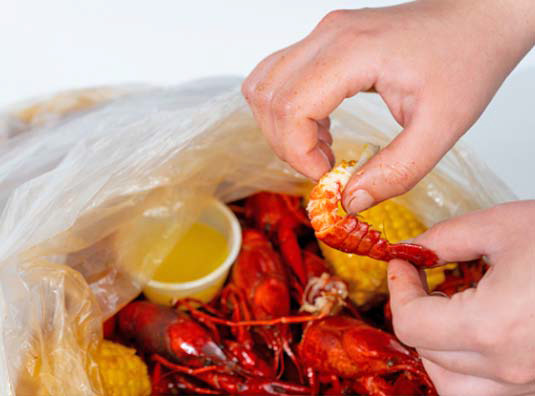
Texas crawfish production is faring better than last year’s dismal harvest, but the industry has not fully recovered to meet consumer demand following multiple rounds of harsh weather conditions this winter, according to a Texas A&M AgriLife Extension Service expert.
Todd Sink, Ph.D., AgriLife Extension aquaculture specialist and director of the AgriLife Extension Aquatic Diagnostics Lab, Bryan-College Station, said drought was the leading contributor to 2024’s poor harvest. But this season multiple freezes and historic snow events across East Texas and Louisiana stunted crawfish growth and delayed some harvests on Southeast Texas farms.
“While we’re doing better than the last two years, we’re nowhere near what I would consider to be a bumper crawfish season,” Sink said. “In order to have a good year, we need to have milder summer temperatures without drought conditions, plenty of rain during the fall and winter prior to harvest, lots of forage production, and a mild winter.”
Crawfish prices expected to be higher While early season harvests were promising in terms of size, Sink said those crawfish were holdovers from the previous year. Now what remains are small field-run crawfish that need more time to grow.
“The cold fronts that passed through early this year dropping temperatures to near freezing slowed crawfish growth, but warmer temperatures have the crawfish gaining size again,” he said.
The lag in supply amid ongoing consumer demand will translate to aboveaverage prices per pound and limited availability in some markets.
Live crawfish are unavailable at many San Antonio retailers, and locations offering boiled crawfish are few and far between, he said.
Sink said live crawfish in Houston are averaging around $4.19 per pound when they would generally be between $2.75-$3 this time of year. In College Station, live crawfish is around $3.77 per pound when available.
In College Station, prices for boiled crawfish range from $8.97-$10.49 per pound. While Houston is seeing slightly lower prices at $6.99-$10.99 per pound, in Dallas the prices range as high as $16 per pound.
Crawfish market trends Because production reporting in Texas is voluntary, precise numbers on farmed acreage and pounds produced per acre are not readily available, Sink said.
“We have about 40 producers in Texas farming close to 18,000 acres,” Sink said. “While Louisiana bases its economic modeling on producing around 650 pounds per acre, we’ve had some Texas producers harvest as much as 850 pounds per acre during a good season.”
Sink said this variation is due to slightly different production methods used in Texas.
While Louisiana heavily utilizes a crawfish-and-rice field rotation, some producers in Texas have transitioned to year-round pond production for crawfish.
“That buys you another two months of harvest, so you can get more per acre because you’re harvesting longer,” Sink said.
Despite the installation of several new farms, Texas ranks No. 2 in crawfish production and still lags far behind Louisiana, the nation’s top producer.
“Unfortunately, we really don’t have enough area left in Texas with suitable water, soil and climate to expand the crawfish industry,” Sink said. “And those regions that do exist, such as the Houston area, are viewed as much more valuable for real estate development.”
Optimistic outlook for future crawfish crops Sink said the success of each crawfish season depends heavily on the conditions of the prior year.
Because last year’s severe drought decimated much of the crawfish crop, there weren’t many crawfish remaining to reproduce for this year’s harvest. However, with adequate rain and forage production, Sink remains optimistic for ongoing recovery.
“We’re starting to build those stocks back up in the ponds,” he said. “As long as the weather and everything holds, next year should be better — and the year after that should be even better.”
AgriLife Extension district reporters compiled the following summary for the Central Texas district: Dry conditions persisted with warm weather. Winds depleted soil moisture levels. High winds and the lack of green grass raised concerns about fire danger. Summer perennials emerged slowly due to dryness. Farmers planted corn. Winter wheat and oats made slow but steady progress, with most livestock turned out on pasture. Some corn and grain sorghum emerged. Cattle prices dropped, while sheep and goat prices held steady.