
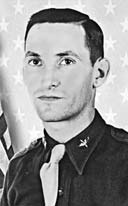
A call has been issued to bring a Dublin-born hero home to Texas as the Lubbock VFW started a petition to recover the remains of pilot Lt. Col. George Andrew Davis who was shot down defending others in the Korean War. The petition can be found at returnourhero.org and was unveiled by Lubbock VFW Commander Sarah Weede on Sept. 20 to coincide with the recognized day for military POW/ MIA.
Of the 31 years of Davis’ life, 10 of it had been spent in the service of his country, during which time he conducted 326 combat missions in two major wars, destroyed an official total of 21 enemy aircraft, and received the Medal of Honor, two Silver Stars, the Distinguished Service Cross, the Distinguished Flying Cross with three Oak Leaf Clusters, the Air Medal with nine Oak Leaf Clusters, and the Purple Heart.
Davis was born Dec. 1, 1920 in Dublin to George A Davis Sr. and Pearl Love Davis. The family moved to Morton where he graduated high school. Davis began his service on March 21, 1942 at Lubbock, Texas, and spent the bulk of the following year in flight training. He was commissioned a 2nd Lieutenant on Feb. 16, 1943, and deployed to the Pacific theater.
By May 3, 1945, the day Davis returned to the United States, he had been promoted twice in the theater of war. In addition, Davis had received the Silver Star and the Distinguished Flying Cross among his many other honors.
Perhaps the most telling achievement of Davis did not come in the form of a medal.
When his role in the Pacific war ended in December 1944, Davis had already become a combat ace, having destroyed seven Japanese aircraft in individual aerial combat.
Davis served several positions stateside and was a member of the aerial demonstration team, the Sabre Dancers before he was called back to action in the Korean War.
In 1951, Davis was promoted to major, sent to South Korea, and given command of the 334th Fighter Squadron.
By February of 1952, Davis had 14 official Korean War air victories to his credit, becoming the first two-time American combat ace in history.
On Feb. 10, 1952, Davis was leading a patrol near the Sinuiju-Yalu River in the northwestern border of the Korean peninsula, when half the patrol was forced to return to base due to mechanical problems with their F-86 Sabre jet fighters. Davis and another pilot continued the patrol and ran headlong into 12 enemy MIG-15 aircraft that had been deployed to attack slow-flying American bombers.
To protect his fellow airmen, Davis dove into the MIG formation, attacking it from the rear.
With a burst from his machine guns, he destroyed the first MIG he encountered. Almost immediately, Davis was pelted by the fire of the remaining MIGs, but he pressed his attack, firing another short burst into an enemy aircraft and sending it smoking to the earth.
At this point in the battle, Davis was flying substantially faster than the enemy MIGs, and could have easily evaded their fire and pursuit, but Davis, aware that 10 more MIGs remained to threaten his brother pilots, slowed his speed to reengage the enemy in combat.
It was then that Davis sustained a direct hit. According to the eyewitness report of a fellow American pilot, Lt. William Littlefield, Davis then lost control of his F-86 and crashed into a mountain 30 miles south of the Yalu River.
However, Davis did manage to create such pandemonium in the Korean skies that day that the American bombers completed their mission in relative safety.
At the time of his death, Davis was the leading ace of the Korean War. For his heroic action on Feb. 10, Davis was posthumously promoted to Lieutenant Colonel and awarded the Medal of Honor at Reese Air Force Base in Lubbock, Texas, the very place where his military career began.
Attending the ceremony was his wife, Doris Forgason Davis, his three children Mary, Charles, and George, and a future president of the United States, Lyndon Baines Johnson.
According to Lubbock VFW Commander Weede there were no remains interred because the Chinese military recovered his tags and whatever remains were left. Weede said it is not know exactly what was left but it has been on display in one of their museums.
Weede said she has sent signed letters to U.S. Representative Jodey Arrington’s office about the matter and intents to forward letters and the list of signatures to as many officials as possible in an effort to bring him back home.
The hope is to get his remains back for Davis to be the first Veteran buries at the West Texas State Veterans Cemetery when it opens next year.
Those who wish to support can sign the petition at returnourhero. org.