

We had an interesting visitor in the museum a few weeks ago. He had grown up in Iowa and knew about the Piano-ette sometimes called the Piano-lin. We have this same type of instrument in the front of the museum hanging on the wall with a violin.
The instrument we have is called a Violin Uke. Many of these instruments were made by the Marx Music Company. The names for these dulcimer type instruments were changed from time to time. Men needing employment would sell them door to door during the depression. These instruments could be bought a case at a time with 8 in a case.
The Violin Uke could be played with no previous experience using the numbers that are painted on the instrument. In theory someone could sit down for the first time and play a song using the numbers that were printed on the music sheet and the instrument. The strings can be plucked or bowed with the accompanying bow. The company also sold music books that had all the necessary numbers already noted on the music page.
Dulcimers and fretless chord zithers were played with folk music and this type of instrument could be played for family gatherings and churches by someone without formal training. It was patented by Oscar Schmidt in 1916.
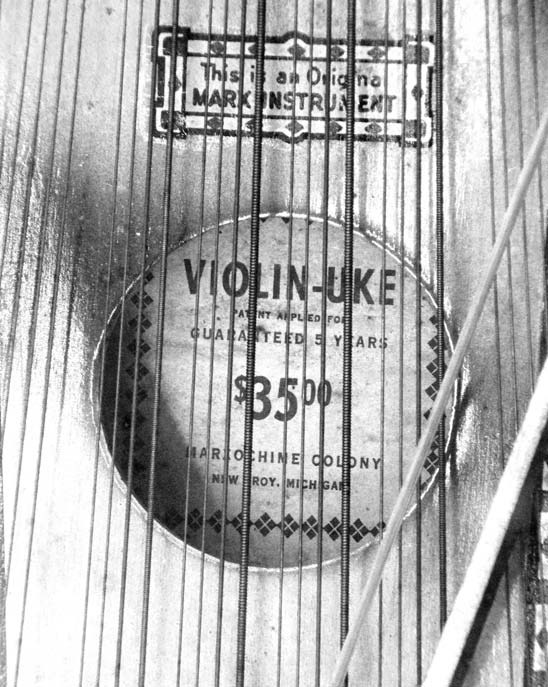
The standard Osborn label appears inside the sound hole and shows the price as $35.00 dollars. Some of the Marx manufactured instruments have stamped on the side “Conservatory Quality.” Some of these types of instruments, built by the Marx company were also marketed as a Marx-ophone.
They were first made in Mount Pleasant, Iowa and later in New Troy, Michigan. Some were marked “This is an original Marx Instrument.”
The one we have in the museum is form 3 “and has all the tuning pins on the same end, the sound hole is near the “13“ note of the melody scale and the chord label nearer the bottom of the bridge.” (fretlesszithers.net) These types of instruments also have what appears to have feet at one end, but it would be impossible to play while standing the instrument on them. It is best played flat on a table positioned so the strings can be bowed. This model of instrument came with the accompanying bow and tuning instrument. It sold for $35 dollars.