
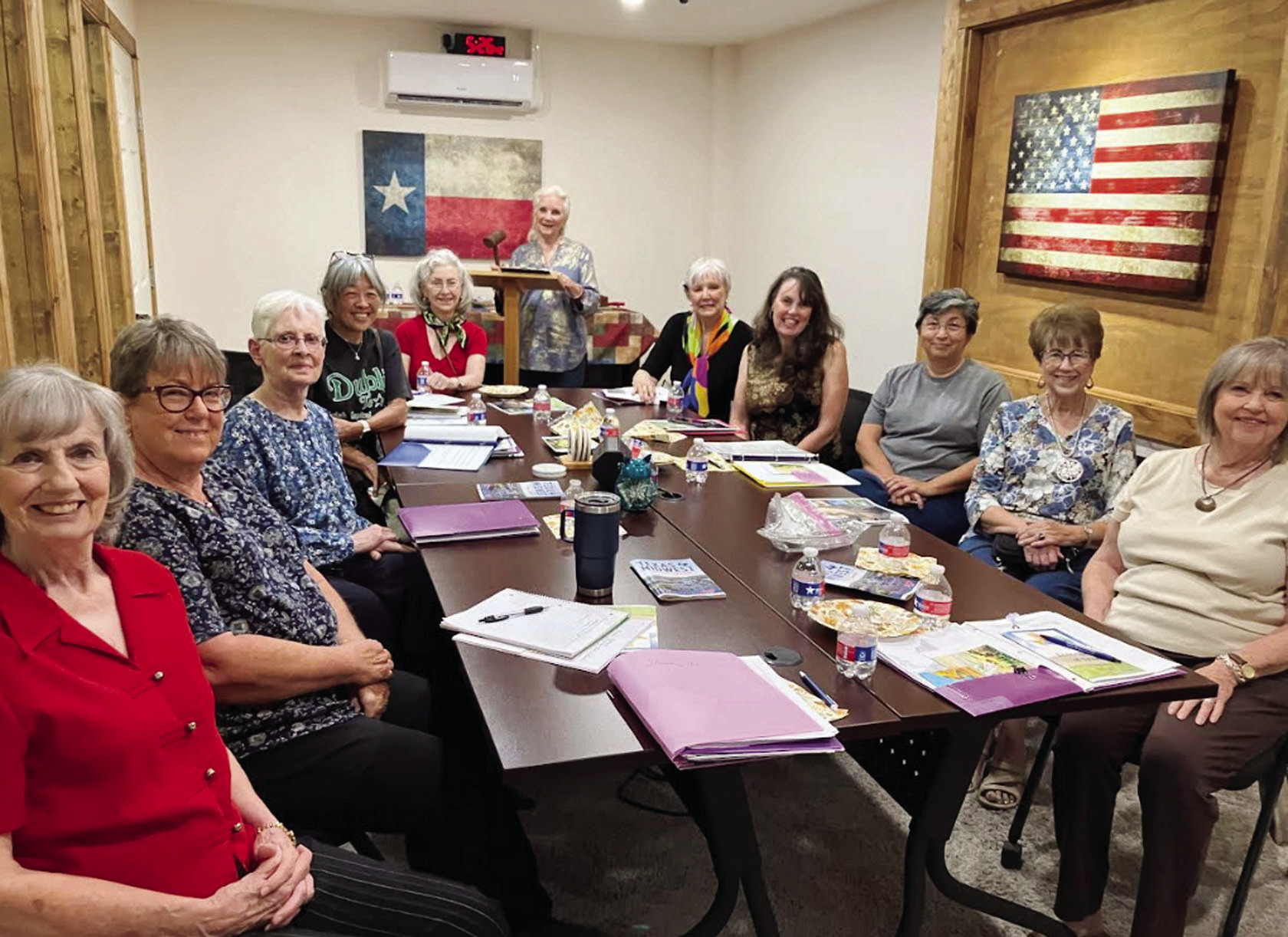
The Woman’s Thursday Club of Dublin met in the conference room at Karen Wright’s Black Jack Office Building.
The meeting was hosted by Patty Hirst, who presented a fine program on the Rolling Plains Ecoregion.
This Ecoregion occupies 24 million acres, and is the next-largest ecoregion, behind the Edward’s Plateau. It lies to the north and west of Erath County, and includes Abilene, San Angelo, and a small finger of it reaches up above Amarillo. Despite its size, its population is a mere 320,000 which is equal to the population of Corpus Christi, alone. 130,000 reside in Abilene, 150,000 in San Angelo, and the balance are scattered in its 26 counties, with an average of only 13 people per square mile.
This area typifies the frontier culture of the Westward Movement. The book, “Empire of the Summer Moon” is set here, and is a great summary of its rich history. Patty shared an image of the famous Columbia painting, which characterizes the west as a dark territory, and the east as the light, ‘civilized’ territory.
Its economy is mainly agricultural, mainly ranching. Some farming is also represented here in its cotton, wheat, sorghum, and grain crops. Although modern irrigation practices and new-fangled farm equipment makes the West Texas farmers’ job a bit easier, he is still at the mercy of Mother Nature. You can be hailed out, blown away, burned out or dried out. Of course, gas and oil are a huge part of the Rolling Plains economy. The population grows and shrinks as the transient workers adjust to activity in that industry. Wind is the newest economic factor. The new windmills on farmland have supplemented the income of many a struggling farmer. The region is also host to recreational hunting, of whitetail deer, quail and geese, with hunters coming mainly from the Fort Worth and Dallas areas.
The Rolling Plains Ecoregion has been reduced from its original splendor, as has all of our ecoregions, mainly due to bulldozing, the lack of maintenance fires (which had naturally occurred in 5-10 year cycles), soil erosion, water damage from the damming of rivers, and the diverting of water for use in agriculture, and overgrazing. Texas Parks and Wildlife projects are working to conserve and manage the ongoing tension between conservation efforts and the resources being exploited. Let us all remember to be good stewards of the land!
Our next meeting will be Thursday, Nov. 13. Edilsia Jimenez will present her report on the South Texas Plains Ecoregion.