
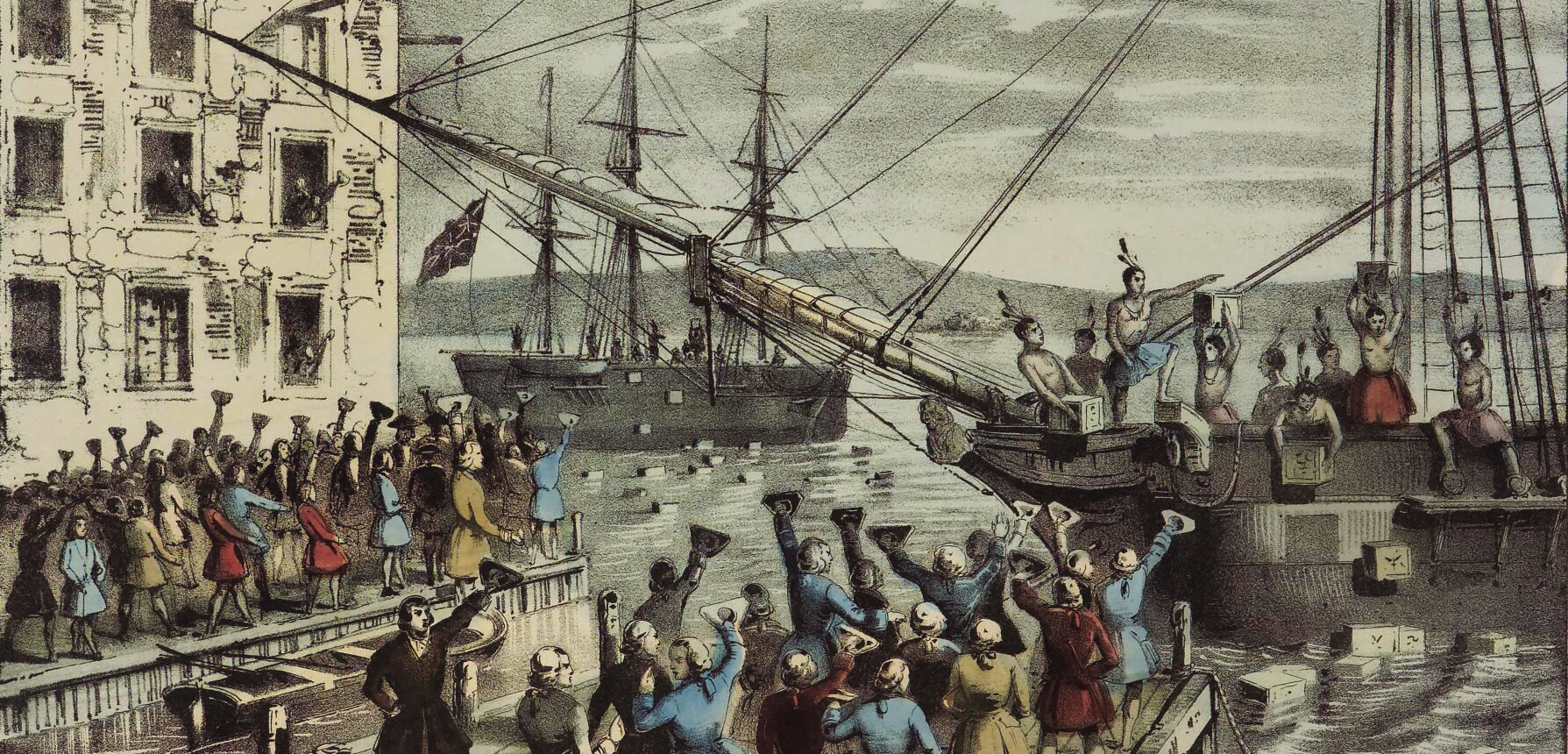
The Boston Tea Party was a protest that took place on December 16, 1773. American patriots had opposed taxation in the colonies because they had no representation in the British Parliament.
In May 10, 1773, the Tax Act was passed, creating the first time The British Parliament imposed a direct tax on the colonies by taxing tea. The Sons of Liberty opposed both the Tea Act feeling that it was taxation without representation and the Townshend Act that imposed restrictions on the colonies.
The Royal Governor of Massachusetts ordered that a duty be paid on ships before they could leave Boston Harbor.
When the ship Dartmouth filled with tea arrived in Boston Harbor, Samuel Adams called for a meeting at Faneuil Hall on November 29, 1773. So many arrived for the meeting that it was moved to the Old South Meeting House. British law required arriving ships to pay duties within 20 days or customs officials could confiscate the cargo. On December 16, the last day of Dartmouth’s deadline, 5000 to 7000 people gathered at the Old South Meeting House. The meeting passed a resolution introduced by Adams urging the captain of Dartmouth to send the ship back to England without paying the import duty. The meeting assigned twentyfive men to watch the ship and prevent the tea from being unloaded. At one point, Samuel Adams tried to control the crowd but the crowd got angry and started leaving. By 6 or 7 o’clock in the evening, a large group of 30 to 130 members of the Sons of Liberty armed with axes, some dressed in Mohawk warrior disguises, went to the wharves. There, three ships were boarded, the Beaver, Dartmouth and the Eleanor. Over a 3 hour period the men dumped all 340 chests of tea into the water. The cargo weighed about 92,616 pounds and was valued at $1,748,138 into today’s money. Paul Revere carried the news of the event to New York City as an express rider.
The protest was originally known as “The Destruction of the Tea.” It later took on the name “Boston Tea Party.” Samuel Adams may or may not have planned the Boston Tea Party, but he later publicized and defended it.
The British government considered this protest an act of treason. Parliament decided to punish Boston and the colonists in Massachusetts by closing the harbor in June 1774 along with issuing new laws ending self-government in Massachusetts.
Other protests soon took place and British Parliament began fearing the colonies would demand independence. This led to the February 1775 Conciliatory Resolution that ended taxation that provided for imperial defense and upkeep of imperial officers. The tea tax was repealed in the Taxation of colonies Act of 1778 but failed at creating reconciliation.
Less than two years later, The Boston Tea Party eventually proved to be one of the events that led to the battles of Lexington and Concord where the eight year American Revolutionary War started. The American colonies demanded independence and eventually won it.
(Wikipedia.org/Boston_ Tea_Party)