
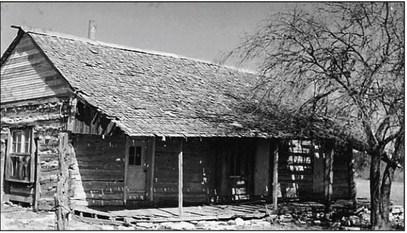

It was in 1855 after Texas had become a state but before Erath County was created out of Bosque and Coryell Counties, that Chesley Turnbow arrived. He came to this part of Texas from Tennessee via Arkansas. He traded two Tennessee horses valued at $500 dollars for five hundred acres of land. It was located about 7 miles south of Dublin in what is now the Edna Hill Community.
Chesley Turnbow built a log cabin soon after. The original cabin was considered to be large and beautiful. It was constructed of Post Oaks that were plentiful in this area. After the logs were put in place, the walls of the cabin were mortared with lime and sand from the banks of Resley Creek. Crude shingles were made from Hackberry or hand hewn Bur Oak timbers. (Chronology of Dublin, Texas by T. R. Rogers, February 1999) The cabin was built about 100 yards from a spring on Resley Creek that had water throughout the year. Large native boulders along the Creek, created a cool spot underneath that food could be stored in. They covered milk jars with a damp cloth for its cooling effect to keep the milk fresh. (Dublin Progress, (3-15-1973)
The cabin had a dog trot, an opening through the center, dividing the cabin into two halves, making it a double cabin. It had large fireplaces on the east and west ends. The walls were built dovetail fashion of Oak logs. Underpinnings were six inch wooden pegs. (The Families of Turnbow Cemetery, Erath County, Texas,Alice Callaway Moore)
In 1857 the Jones Barbee family was on a trek from North Carolina to a more prosperous place in Texas, heading to Wilson Community. The Barbee wagon broke down forcing the family to stop for a few days until it could be repaired. They came to the cabin, often referred to as the “Big House,” to protect themselves from the marauding Indians and to make plans. During that time Jones Barbee learned that the cabin and 500 acres were for sale. (Dublin Progress, (3-15-1973)
It was on September 25, 1858 that Chesley and his wife Sabra sold their land and the large double log cabin to Jones Barbee for $1250. Later, on the far corner of the property, a cemetery was created in order to bury their 6 year old grandson Tommy Cabell who died of yellow fever in 1863. This cabin served as home for family members for a hundred years. (The Families of Turnbow Cemetery, Erath County, Texas, Alice Callaway Moore)
In 1973, the well preserved Turnbow-Barbee Cabin was the number 1 registered cabin in Erath County. It was donated to the Dublin Historical Society with the intent to move it to Dublin where it would be renovated and preserved for future generations to enjoy. As planned, the Barbee cabin was torn down and the logs were moved to Wright Park for short term storage. (Dublin Progress,7-181974)
A place was decided on where the cabin could be assembled and citizens were asked to volunteer money and time to start the rebuilding. Work was also in progress installing new windows and doors at the grist mill. (Dublin Progress, 1-22-1976)
Danny Prater who actually had lived in the cabin at one time, became an agriculture teacher and asked his class to volunteer time organizing the logs that had been brought to town. (Dublin Progress, 4-1-1976)
Weeks later, Prater’s students once again helped the project by pouring the concrete foundation for the log cabin. (Dublin Progress, 5-27-1976)
Logs were slowly put in place to restore the original beauty of the cabin. Some of the logs were too weather damaged to be used, so it was decided to use only the good logs in the new structure. The cabin in Wright Park is smaller than the original because only the best logs were used in the rebuilding process. By July of the next year, the walls were up and the fireplace needed to be put in place. Lila Smith-Utterback stated to the Dublin Progress that donations were needed to complete the project and furnish the inside. Some of the furniture to be placed inside was actually the original furniture from the 120 year old structure. A large donation was made to the cabin fund in memory of C. E. Leatherwood, a long time community leader who had passed away. By late summer of 1977, the cabin was for the most part complete with the outer walls, door frame, window frames and roof finished. The chinking of the walls was all that remained.
Chinking was a process of filling the gaps between the logs with mud or concrete to keep the cold wind out. (Dublin Progress, 7-21-77) Lee Meek who was working with a special grant program, put the final touches on the walls, chimney and fireplace in June of 1978. He also built the rock wall that is still seen in Wright Park. (Dublin Progress 6-151978)
For Dublin Historical Society information scan here!