
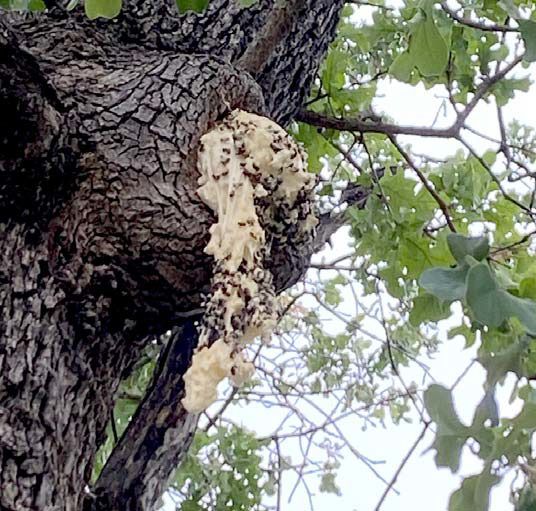
Homeowners around Dublin are cautioning others to be wary of bee activity after altercations with aggressive hives last week, one around Highland and one in Proctor.
This follows a May 9 bee attack that claimed three horses in Comanche County and an April 27 attack in Eastland that claimed the life of Steve Daniels as he attempted to escape in his vehicle and crashed after the bees followed him inside.
On Saturday, May 17, Dublin ISD coach Wes Grisham was exiting his home near the Highland community just after a storm.
“I walked outside my front door and before I knew it was swarmed,” he said.
Grisham now theorizes that the storm had displaced a hive because they had set up on the upper awning of his front porch.
The coach rushed back inside and within five minutes, a few had made it inside and were attacking his dog. Grisham rushed his family into a bedroom closet as he shut doors and blocked any crevice they could enter.
It took a couple of days before a beekeeper could make it to the home. In that time, the dog was stung five times by loose bees that had made it into the ventilation. The beekeeper found the hive unsuccessfully tried to make it into the attic, but had developed three large combs in the hive set up on the porch.
Grisham said they have a lot of trees and expected they had come from one of those following the storm so he encourages others to be observant when outside.
“It wasn’t fun but it was a good learning experience,” he said.
Another person urging caution is Proctor’s Debbie Noel, who had to be rushed to the hospital to get 80 stingers removed following a May 20 attack.
Noel is no stranger to bees so she was well covered when she got on her mower. She had checked a nearby dead tree for bees as they like to nest inside hollows and the recent storms have created some apt spots for them.
She missed the hive inside one of the prettier trees so was surprised when the engine noise drew a swarm as she passed by on the mower. Noel said there was only a small opening on her face between her hat, large sunglasses and neck gaiter. (She also wore long sleeves, pants and gloves.)
She felt one get her cheek and realized after a second that it was a sting. As she swatted it away, the gaiter fell loose and they started attacking her face and got inside her sunglasses.
They were “trying to get up my nose, in my ears, stinging my lips and inside my sunglasses on my eyelids,” she reported.
As this ensued, her hat was knocked off, and they got into her hair.
She had her cell phone and attempted to dial 9-1-1, but she had to remove a glove and the bees started to sting the free hand.
Noel is grateful to the operator who stayed on the phone with her and told her to run for her home.
“She asked if I could run,” Noel said. “I said, ‘I’m 68. I’ll do my best.”
Noel managed to get away from most of them, with only three following her into the house (which she dazed with fly spray).
An EMT donned protective gear and met Noel at her door and escorted her to the ambulance.
“They pulled over 80 stingers from my head,” Noel said. “I looked like a porcupine and my vocal chords were strained from screaming.”
She also uncovered more stingers as the swelling went down.
In spite of all this, Noel has a positive attitude, joking that she looked like she had been in a fight with Mike Tyson and offering her gratitude to God that it was her who was attacked because she was well covered and was a little familiar with bee habits.
She was also more prepared because she was just finishing a round of steroids to treat tendinitis in her foot.
Noel said she appreciates her honeybees but these seemed much more aggressive than usual.
She encourages people mowing to check their trees (particularly hollows where they like to nest), wear protective clothing and always carry their cell phone while outside.
For more tips see Mike Berry’s column on page B3.