

During the August 24, 1814 attack on Washington D.C. the British Army burned the public buildings including the United States Capital, the Washington Navy Yard and the White House saving only privately owned buildings. Old Dr. William Beanes was arrested and taken prisoner after the Washington attack and the Raid on Alexandria for detention of several British Army stragglers who were ransacking citizens homes looking for food. (Wikipedia, Burning of Washington) By September 14, Francis Scott Key, a Washington D.C. lawyer wrote a letter from his home to his mother saying that he was going to try to try to get the British to release Old Dr. William Beanes of Upper Marlboro.
Friends had urged Key to go and try to get him. Under sanction from President James Madison, he traveled 40 miles to Baltimore where he located Col. John Stuart Skinner, an American agent for prisoners of war who leased a 60 foot sloop rigged ship belonging to John and Benjamin Ferguson. Skinner agreed to help and they sailed from Baltimore on Sept. 5, 1814. They rendezvoused with the HMS Royal Oak and several British ships near the mouth of the Patuxant river. There they learned that Beanes was aboard the truce ship HMS Tonnant further down the bay. After finding it, they were allowed to board. There, Skinner and Key secured the release of Beanes after conversing with Major-General Robert Ross and Vice-Admiral Alexander Cochrane. At first he didn’t want to release the prisoner, but after reading letters brought by Key written by wounded British prisoners of war praising the doctors for their kind treatment he agreed to release him.
During the negotiation, Key and Skinner overheard plans for an attack on Baltimore. Not wanting them to share that information, Cochrane prevented Key and Skinner from going ashore until after the battle.From the Tonnant, Key, Skinner, and Dr. Beanes were transferred to the frigate HMS Surprise on September 8. The armada moved up the Chesapeake toward Baltimore. On September 13, 1814, the attack group advanced into the Patapsco River, the 16 British ships began firing on Fort McHenry at sunrise. During the bombardment, Key witnessed the fort’s smaller storm flag continuing to fly. The British ships tried to get close enough for their cannons to hit the fort, but when they did, the powerful cannons at Fort McHenry would force them back to a distance. During the attack HMS Erebus launched “rockets red glare” while the heavy mortar bomb ships HMS Terror, Volcano, Devastation, Meteor and Aetna provided the “bombs bursting in air”. Around 1500 to 1800 bomb shells and over 700 rockets had been fired at the fort. Four men at Fort McHenry died and 24 were injured in the battle.
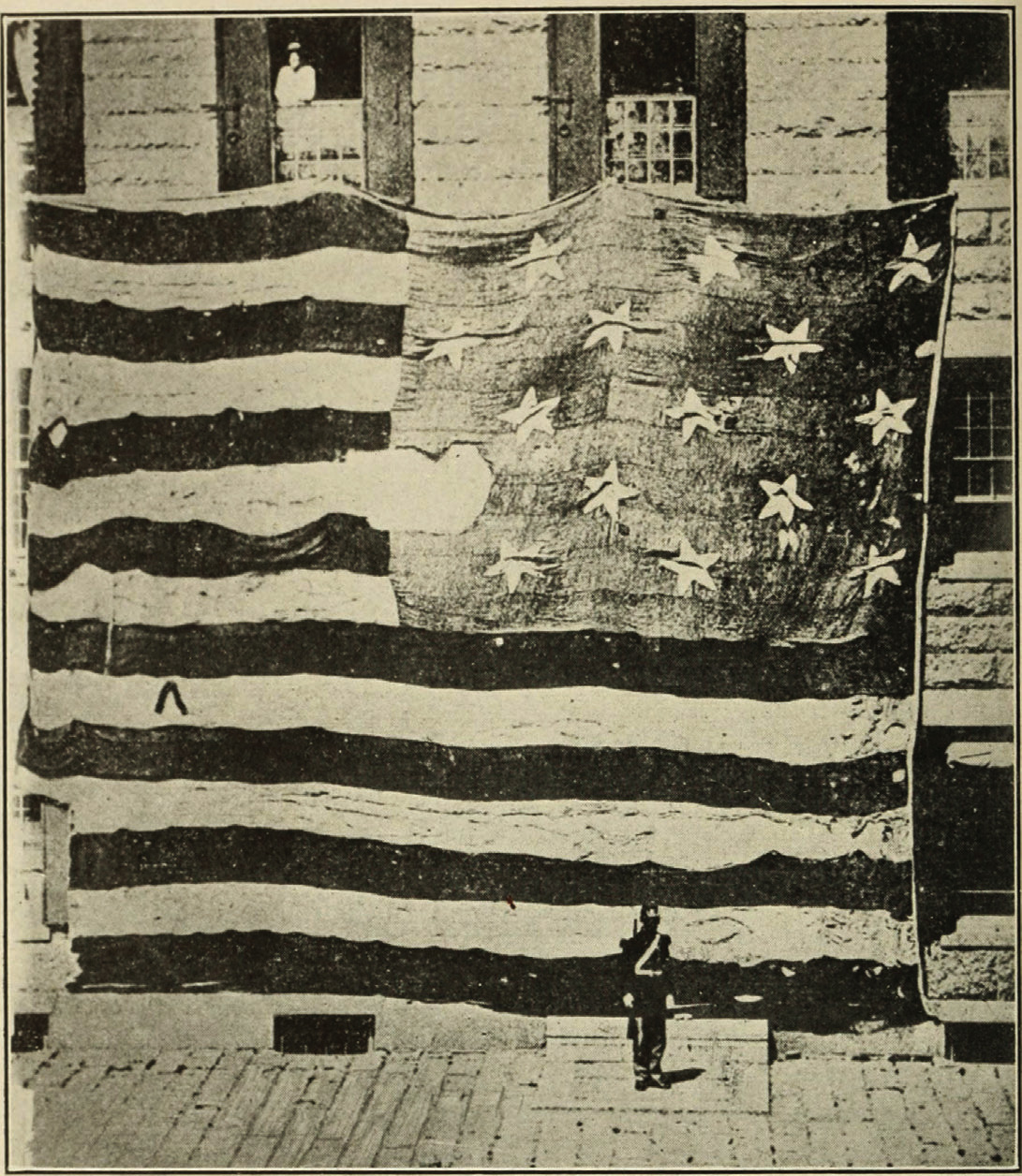
The attack on Fort McHenry lasted 25 hours, from dawn till dawn the next day. Through the rainy day and night Key had witnessed the bombardment. After the bomb and rocket barrage ended, it wasn’t until sunrise the next day that Key was able to tell the outcome. Fort McHenry had been flying a smaller flag through the night, but at dawn the patriots raised the impressive Garrison Flag over the fort. Sewn by Mary Young Pickersgill in her home on Baltimore’s Pratt Street, the impressive Garrison Flag had 15 stars and 15 stripes and was 30 feet high and 42 feet long.
The large and colorful Flag inspired the words that Francis Scott Key wrote on the back of an envelope. It was originally titled “Defence of Fort McHenry.” He was inspired by the victory over the British and by the sight of the huge American flag flying over the fort at dawn.
Much of the idea of the poem, along with the flag imagery came from an earlier song by Key also set to the tune of “The Anacreontic Song.” The song quickly became popular and was printed in 17 newspapers. In 1889 the US. Navy adopted “The Star-Spangled Banner” and it was played at appropriate occasions. The Senate passed a bill on March 3, 1931. President Herbert Hoover signed the bill on March 4, 1931 adopting “The Star-Spangled Banner” as the national anthem of the United States of America. (Wikipedia, Star Spangled Banner)