
On May 12, 2026 it will be one hundred years since Dublin paved its streets with brick. In this article I want to share the process they went through preparing for and getting the streets paved with the red Thurber brick.
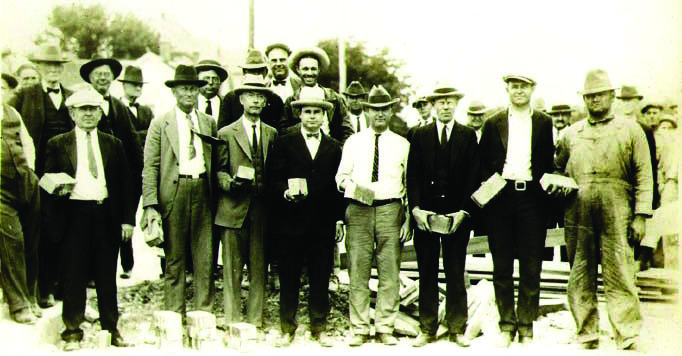
It started in 1919 when Mayor Sheehan visited several cities to ask how paving would be possible for a town like Dublin. He had taken a trip to Dallas, Austin, San Antonio and Cisco. After talking with commissioners in those cities, he announced that “We should be making plans for this to take place.” (Dublin Progress May 16, 1919) “The mayor has an opinion from the attorney general to the effect that upon the vote of the people, the city council may adopt an ordinance ordering the paving of any street or alley and when this is done the cost may be legally placed against the property owners on a basis of one-third to be paid by the city and two-thirds by the property owners whose property abuts on the street or alley to be paved.” “It is stated there will be no trouble encountered in securing the necessary number of signers.” (Dublin Progress, June 27, 1919) An election was scheduled for October 6, 1925 asking for citizens to approve a bond for the City of Dublin for the amount of $40,000 to pay for the materials and labor needed for the paving downtown. (Dublin Progress, September 4, 1925) The bond proposed a property tax of 25 cents per $100 that would pay the city’s part of the cost. They planned to pave with vitrified Thurber brick which had been found to be most satisfactory, more economical, to last longer and may be kept in repair for less money than other materials used for paving. ( Dublin Progress, September 4, 1925) Only 9000 of the nine pound brick was shipped on each rail car. 120 cars with 81,000 pound capacity each were needed. It totaled 1,080,000 bricks for the project. In addition to the vast amount of brick needed, ten car loads of asphalt, four or five car loads of gravel and twenty car loads of sand were needed, not to mention the vast amount of labor needed. (Dublin Progress, February 5, 1926) This first phase of paving took place from the Magnolia filling station at the corner of Live Oak and Patrick, down Patrick Street to the red light. Work continued from the train tracks on Blackjack to Park Street. On Elm Street it went from the train tracks to Park Street. Also Grafton Street from the Katy train station to Live Oak Street. (Dublin Progress, September 4, 1925) For weeks the crews had been putting down curbing and preparing the streets. It was on May 12, 1926 late in the afternoon that the city council gathered to have a ground breaking ceremony to officially start the paving with brick. The people had seen what the curbing would look like. But after the councilmen and Mayor E.C. Fewell put down their brick in the ceremony, the real brick layers quickly moved in and started the brick laying process. The crews quickly worked toward the corner of Patrick and Blackjack. It was hoped that the new brick streets would bring new life and encouragement to businesses downtown. (Dublin Progress, May 14, 1926) It was during the paving process that the Frisco asked the Jake Hamon Railroad to stop using the Frisco freight station for freight business and build their own building.
J.W. Mitchell arrived on March, 24 to agree to start building their own depot and to agree to pay their part of the costs of laying brick on the downtown streets. General Manager of the Frisco and attorney Odell arrived the same day to talk with the Dublin council and confirm their willingness to pay their part of the expense of brick paving. For the Jake Hamon line the materials for the new depot arrived on five cars and work began shortly thereafter. The building size was eighteen by forty-two feet. That railroad depot is now part of the Erath County tax office on Grafton Street. (March 26, 1926) By August, work had continued in each direction until the paving was done in the downtown section.
Everyone was so pleased with the paving downtown, a number asked for a second bond to pave other streets including residential neighborhoods. That election took place on October 5, 1926. The next section was to pave Patrick Street from Live Oak to Clinton Street where it stopped at the gas station. That gas station is where the Dairy Queen is located now. Some additional paving was done downtown, One part of Blackjack Street was extended to the Jake Hamon Railroad crossing close to Highland Ave. East Elm street was later paved along with North Grafton.
The Historical Society is planning to have a celebration on May 9th at the museum for the 100th anniversary of the downtown brick. More details to come.