
Childhood friends William Harley and Arthur Davidson shared a fascination with bicycles and motorcycles. They worked together creating their first motorcycle in 1903 in a backyard 10' by 15' shed. After they completed their first prototype, they immediately began working on their second design using improvements they had learned about on their first model. Several years later, in 1906 Harley-Davidson built their first factory on Chestnut Street in Milwaukee.
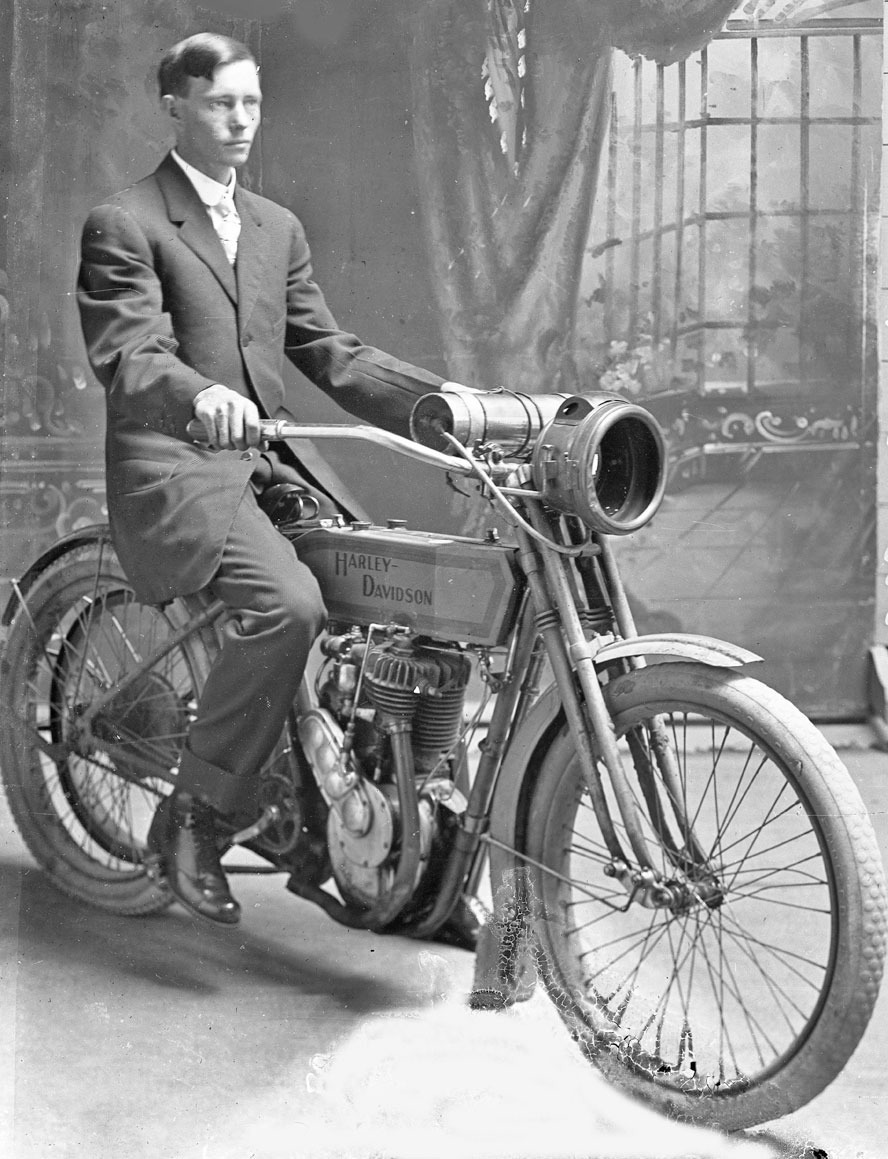
(Wikipedia / Harley-Davidson) We continue to find interesting images in the Ralph and Dossie Rogers collection of negatives. This image was taken on a glass plate suggesting that it was recorded around 1915-1917. It is a gentleman on a Harley Davidson motorcycle. Looking at the features of the motorcycle, it has the features of a 1912 Harley-Davidson 8A Twin model. One of these recently sold for $235,500. (hotcars. com) The two cylinder engine had a 26.84 cubic inch displacement (440 cc). The engine could propel the bike up to 60 miles an hour.
On the back wheel there is a large pulley that takes a leather strap to connect it with the motor. I was told by a local expert that it had two tanks on it. One held gasoline and the other held oil. When servicing the bike, one would put gas in one tank and oil in the other. There was no oil pan on the engine. Oil simply dripped through the engine and onto the ground. It was necessary to fill both the gas tank and the oil tank often.
Our friend on the bike is dressed up for the day’s ride. The bike itself is not new. The photo shows it has a broken spoke on the front wheel and several nicks on the front tire. It must have been new to him to be all dressed up and have his picture taken.
The headlight on this bike appears to be a carbide lamp. They were dangerous but could create light needed to travel at night. The light worked by combining calcium carbide with water. The acetylene gas would burn bright enough to light the way.
The Harley-Davidson company is one of two motorcycle companies that survived the great depression. During World War I and World War II Harley-Davidson provided motorcycles to the military.