

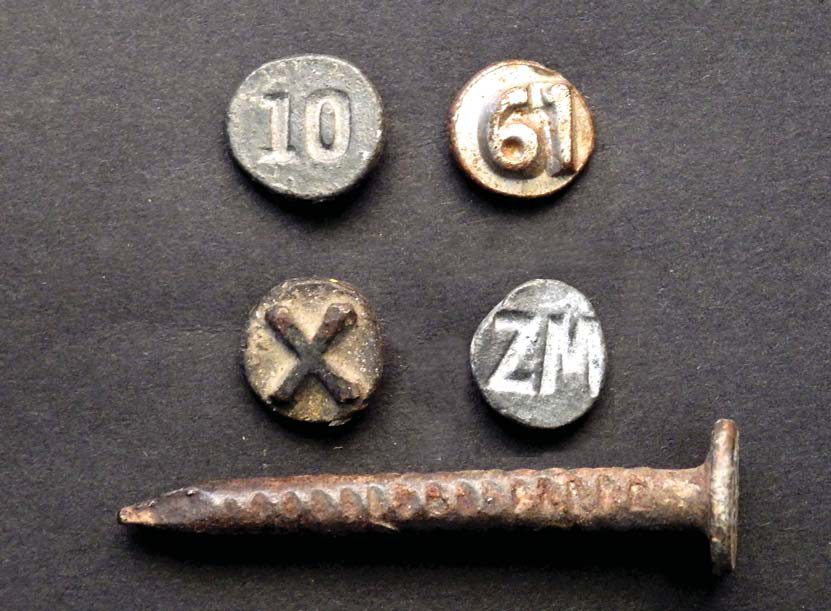

We have an interesting collection of railroad tie date nails in the museum. When railroads first started expanding across America, the wooden ties that held the rails together only lasted 5 or 6 years. It became important to document how old the ties were so they knew when they needed to be replaced. Eventually the railroads started testing treatments for the ties so they would last longer. Eventually the chemical treatments would allow them to last as long as 30 years.
Our collection shows the various types of nails that were used over the years. The date is usually displayed in one or two numbers on the head of the nail, so that a nail used in 1910 would be displayed as a 10 on top. They could be nailed into the cross tie when it was treated or when it was put down in the roadbed.
Some nails have the number sticking up from the nail while others had the numbers inset into the nail head. Various markings had meaning to the railroad. In some cases it was just the manufacturer who made the nail that determined the look of the nail. There were a number of nail manufacturers and the railroads often had to buy from whoever had some available. (Railroad Tie Club of America) Most of the nails were just over 2 inches long. The markings on the shafts indicated what company made the nail. There are collectors in the United States who have organized the nails by type. They are able to describe the nail by type so that other collectors will understand.
Some nails have letters on them. A “ZM” on the head probably means it has been treated with zinc. An “X” on the head often means that there was a problem with the tie when it left the treatment factory such as the end of the tie was splitting but was still usable. A tie that was made of Fir might have a nail with an F on it.
With computers becoming more usable in the late 1960s, this caused the end of the date nail era. A serial number on the end of the tie could be saved with all additional information for each tie in a computer. Some ask if the nails held anything down. No, they did not. Their only purpose was to establish the date that the tie was placed into service or left the treatment plant.
Collectors have for years walked the tracks and noted what nails the different railroad used on sections of track. (Texas Date Nail Collectors Association)(Model T Ford Club of America)
For Dublin Historical Society information scan here!