

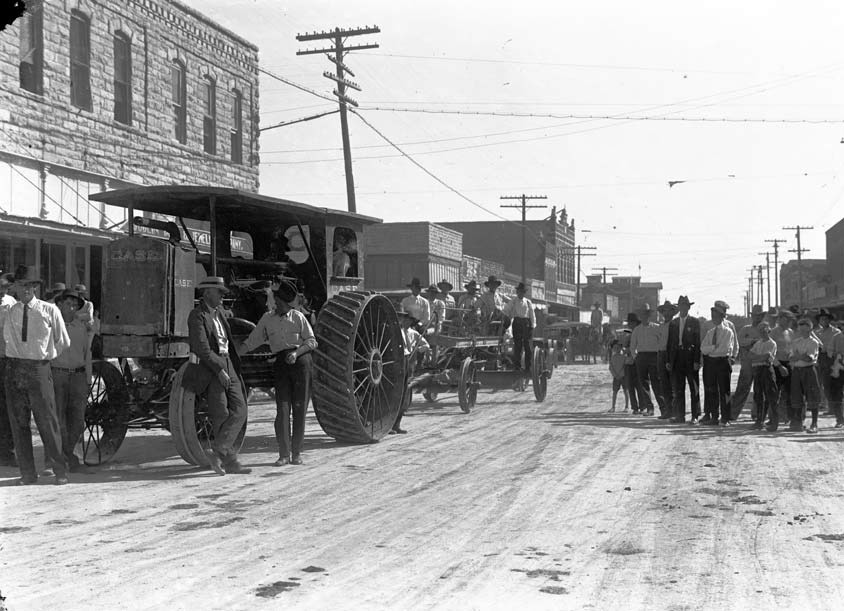
In the early years, tractors were a luxury that most farmers couldn’t afford. Many had horses and didn’t really see a need for having one of those new fangled machines anyway.
The earliest tractors were steam powered. They were big and heavy. The problem was when they were moving on moist soil, they were so heavy that they would sink into the ground requiring a major undertaking to get them back out. It also took a long time for steam powered tractors to warm up where they would operate efficiently. It just didn’t fit most farming needs.
Henry Ford had grownup on a farm and was aware of the problems that farmers had making a living. He thought that a light weight tractor, simple enough to work on and economical enough to buy and operate was what the farmer would want. Gasoline powered tractors were better suited to farming and didn’t take the long warm-up period that steam powered tractors required. (Wikipedia/Tractor/ History) The board at the Ford Motor Company was not really interested in making farm equipment. They were making plenty of money building automobiles. Henry wrestled with them to get them to agree to start developing a economical tractor. The board didn’t want to have anything to do with it.
The only way he was going to be able to develop a farm tractor was to start a new company, so he did. His first tractors were made under the name of Henry Ford and Son Inc. The Fordson tractor was the first lightweight, massproduced tractor that most farmers could afford to buy. It was introduced in 1917 with the model F. It rapidly became the most popular tractor in America. (Crest Capital. com) Farmers benefited from the efficiency of the tractor. A team of horses would become exhausted after 2 or 3 hours of work. A gasoline powered tractor would keep going. Early tractors used metal or wooden wheels. Rubber tires were introduced in the late 1920s and early 1930s.
The Ford-Ferguson 9N came out in 1939. It had a side valve, four-cylinder engine with a 81mm bore and a 95mm stroke. The displacement was 120 cubic inches. It weighed 2340 pounds and sold for $ 585. It came with a 3 speed transmission plus a 3 point hitch that was developed by Ferguson. The Ford 2N was made startling in 1942 and the 8N was made starting in 1948.
Meanwhile, John Deere was also developing some of the most reliable tractors ever made. John Deere began by making the first self cleaning plow. Farmers trying to plow the Midwest prairie found the soil clung to the plow and every few feet it had to be scraped off. John Deere developed a plow with a polished surface that didn’t need cleaning. In 1923 John Deere produced its model D tractor that featured a two cylinder engine that ran on kerosene. Many referred to the two cylinder engines as a “Popin’ Johnny.” It produced 15 horsepower at the draw bar and 22 horsepower at the belt. Parts are still available for the Model D tractor. (about/deere/ history- heritage) In 1945 tractor power on American farms surpassed the horse. Farmers never looked back. The efficiency of the tractor allowed them to plow increased acreage, make a bigger income and enabled their families to live better.