

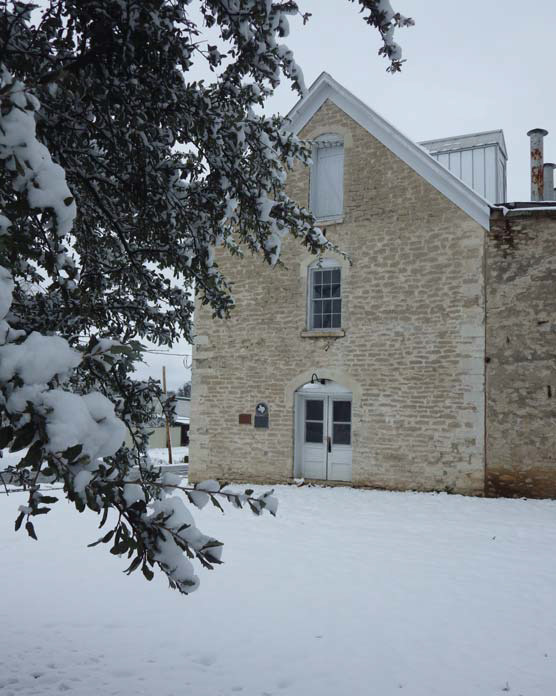
(Editor's note: The Grist Mill is on this weekend's Tour of Homes and can be seen by purchasing tickets through the Dublin Garden Club.)
Grist Mill owner W.T. Miller moved to Dublin in 1876. Old Dublin at that time was located about a mile south of the current location of the town. He had some businesses milling there. After the Texas Central Railroad passed through Dublin in 1880 he wanted to move his business north to the new location of the town. It was in the spring of 1882 that he contacted Joe. E. Bishop, Rocky Davis and Old Frank Hamilton and work started on a new rock grist mill that was finished in late 1882-1883. His new mill was the first rock building in the new thriving town. Wooden frame buildings were considered to be temporary housing for businesses. Having a rock building was a statement that Dublin felt they were here to stay.
The final building had four stories, a basement and three stories above ground. There is some question about why he built the building so large because the grinding equipment for corn and wheat was not large.
It originally had a steam engine to power the equipment located in back of the building. It was never water powered, even with a creek located just behind the building because there wasn’t enough water running in the creek to use it as reliable power. The Steam engine was later replaced with an oil powered engine.
Later the building was reconfigured to have a grain storage building built right next to the mill. The 1921 Sanborn maps show the building enlargement with the 3 section storage sometimes called a grain elevator. New equipment was purchased to move the grain anywhere it was needed in the building. Belts with attached cups would carry the grain to the top floor. From there the grain could be carried outside where it traveled along the north side of the grain storage building and could be dumped into any of the three available bins. From there when the grain was needed, a chute could be opened in the basement of the mill and augers along the wall of the basement could bring the grain once again to the belts and cups to be taken to the top floor of the mill to be processed through the machinery and eventually sacked and delivered to the farmer.
The building stopped operation as a mill and became a feed store where pre-sacked grain and feed was stored and sold. As the building weathered through the years, it was donated to the Dublin Historical Society along with the park land by the Robbins family to be used as a park in the downtown area of Dublin. It was named honoring W. M Wright, Ben Robbins' father-in-law.
The cabin on the property, was from the original Turnbow-Barbee cabin that was first built as a cabin and was used as a stop by the Fort Worth to Yuma Arizona Stagecoach line. It also served as a fort storing horse feed for the soldiers horses who were guarding the line of forts that were built along the line separating the settled and unsettled parts of the old west. Because the original cabin was built in two parts some referred to it as the “double-inn” serving travelers and riders on the stagecoach as well as a rest stop for the horses.