
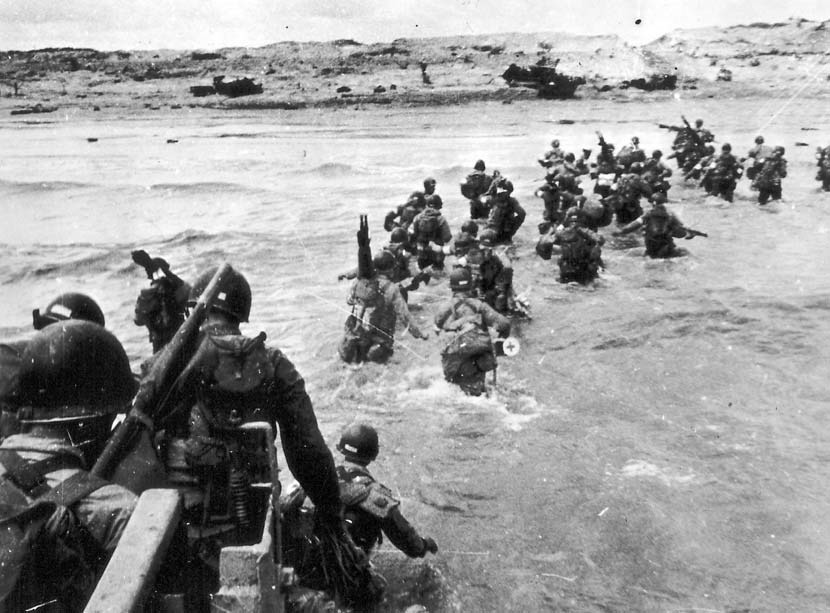

On June 6, 2024 it was 80 years since 156,000 American, British and Canadian troops set foot on the beaches of Normandy, France to fight for freedom in the world. The logistics of the invasion made it one of the greatest amphibious operations in military history. The operation given the code name “Overlord” involved men landing on the beaches of Normandy as well as soldiers delivered by land, air and sea. ( Wikipedia, D Day)(history.com) The Army Air Force had been bombing strategic military targets since 1942. Our Dublin son, Noel Shoup was part of that campaign to weaken the Nazi military machine so that an invasion of Europe by freedom loving men from all over the world could start the march from the beaches of Normandy to Berlin.
Bill Cowan, who served as our Dublin Postmaster for a number of years was on Utah Beach that morning. He was 28 years old and somewhat older than many of the young men he was with. As the young men around him were shocked to see what was going on, Bill was the rock that continued to lead them. “Keep moving forward, keep moving” he told them.
Utah Beach had some of the lightest causalities of the invasion. Out of the 23,000 men only 197 were killed in the amphibian operation.
For many at Omaha Beach the battle was more brutal. It wasn’t just the death of the men around them, it was the mental anguish that would follow them for years that would make it one of the most important events in human history. It was something they would remember for the rest of their lives. The battle at Omaha Beach was portrayed in the movie “Saving Private Ryan.” (U.S. Department of Defense, D-Day: The Beaches) Airborne landings at Utah began at 0015, H-Hour Paratroopers landed four miles inland to secure the area for additional airborne landings and to take out German forces so the amphibious landings that Bill Cowan took part, could take place at 0630. The first to jump were able to mark landing areas, set up beacons to guide the main body of the troops and planes that followed. The final airborne troops landed in gliders on the marked landing areas. (the d-day story.com) Part of the reason for the lack of causalities was Hitler had sent many of his Utah area troops to the eastern front to be part of operation Barbarossa. There, they were to invade Russia. Hitler was so sure of a swift victory that the troops were sent in summertime uniforms. As the battles dragged on, summer turned to fall and then to winter. Though German troops were just 20 miles from Moscow, winter started setting in. With the sub-zero temperatures, motor oil in their vehicles froze and forced the German soldiers to light fires beneath their trucks to melt the motor oil so they would start.
Their tight machine tolerances caused their guns small and large to seize up because of the cold. German soldiers fell, froze or starved to death even before the surrender of the sixth army. (Quora. com, Nazi guns broke because of the cold) “The winter that halted the German advance was the coldest for 140 years.” (Andrew Knighton, War History Online) The 4th infantry that Bill Cowan was part of, fought in the “Battle of the Bulge.” American troops had moved quickly across Bavaria and the German Army came in behind and tried to surround them. Ultimately the Germans were driven back by our army for the final stages of the war.
It was during the very end of the war, that American troops entered the German homeland. It was there that they found the atrocities that the Nazis committed. The 4th Infantry freed Dachau Concentration Camp. The main camp was liberated on April, 29, 1945. Dachau originally was used to house political prisoners who opposed Hitler. At least 25,613 prisoners were murdered at the camp. There were 32,000 documented deaths and thousands more that were undocumented. “After liberation, prisoners weakened beyond recovery by the starvation conditions continued to die.” (Wikipedia, Dachau concentration camp) Today we share this information to remind us how American soldiers served their country and their fellow man. Many did not come home. Those that did, shared their stories for us to ponder. Freedom is not free. It is a long path that we follow so that those who live after us will be able to fully live their hopes and dreams.