
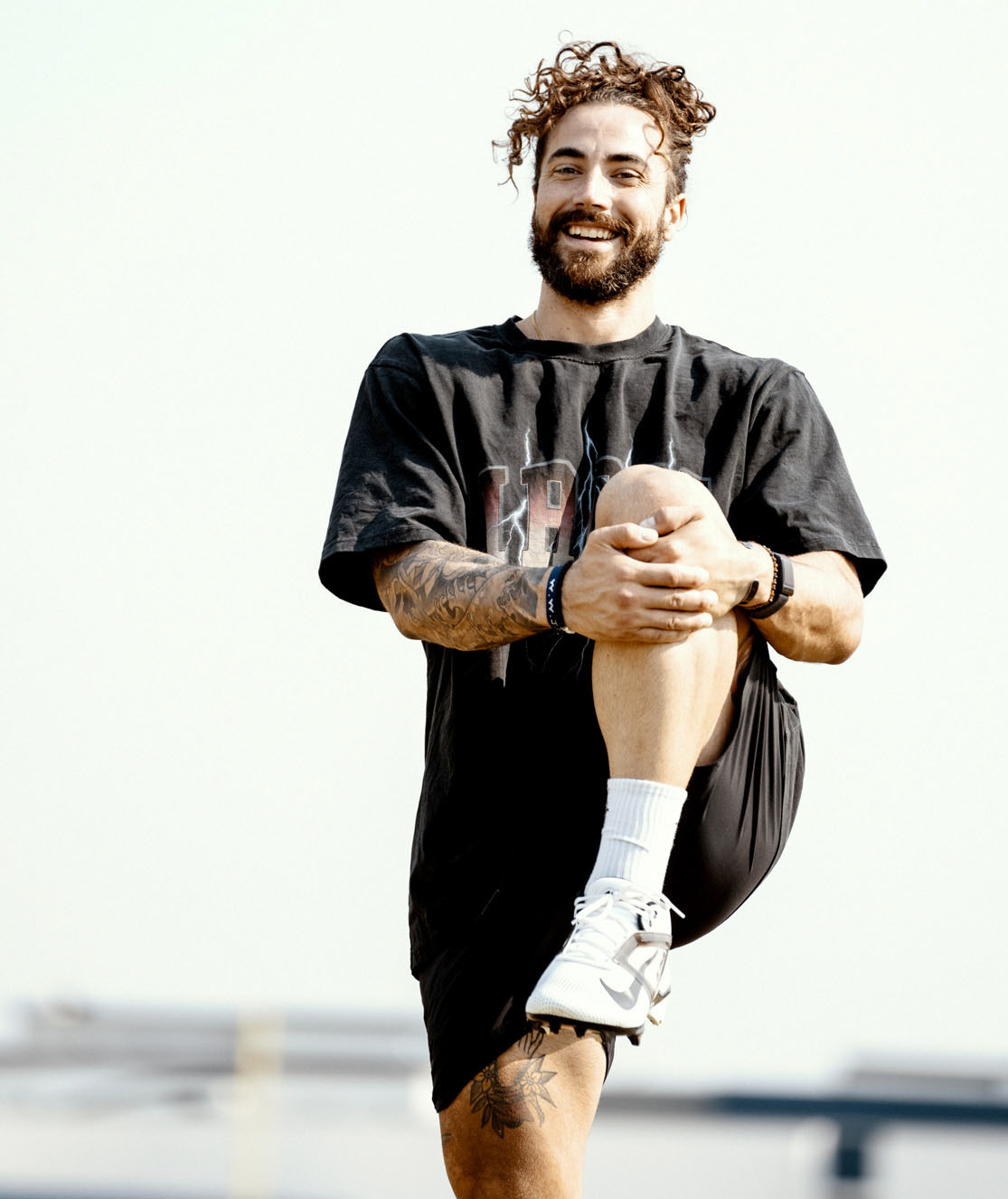
Dublin-born Wes Budge always loved sports, but injuries in high school and college prevented him from playing as much as he wanted to. But his love and knowledge of sports and sports medicine drew Budge to stay close to the field. Now, he runs his own sports performance facility in Arizona, working with a clientele of professional athletes from the MLB and NFL.
“I went through this period of depression after my second knee surgery because my sport was taken from me,” he said. “I had to overcome that. But once I overcame it, I started realizing, ‘Wow, everything that I learned from my sport I’m now I’m able to apply into my everyday life — my work ethic, my grit, that sort of thing.’ The injury took something that I saw as something I was going to have long-term in my life, but it manifested into something better than I could have ever imagined.”
Budge’s family came to Texas because his grandfather Al Lueck was a dairyman and wanted to run a dairy in Erath County. Budge was born in Dublin and lived here until he was 10 years old, when he and his parents moved to Arizona.
There, he played football in high school and planned to play in college. Before he graduated in 2010, he suffered a torn ACL and had to put his dreams on hold while he recovered. After graduating high school, he went to Northern Arizona University in Flagstaff, then transferred to Scottsdale Community College, where he played football for a year. “Going into my second year there, I was injured again — same knee, same injury,” he said.
Budge ended up transferring to Arizona State University and graduating in 2016 with a bachelors in kinesiology. After graduating, Budge took on a six-month long unpaid internship with Fischer Institute of Physical Therapy and Sports Performance. “I was grinding it out, basically taking any job that I could within the facility to try to make myself as valuable as possible during my internship,” he said.
That internship led to a part-time job. “They would basically let me clock in to do odd jobs,” he said. “I was working as a physical therapy tech. I would do back office billing. I would do front office billing, scheduling, everything I could. At the time I hated it, but it catapulted me to where I’m at now.”
Budge continued to work at the institute and moved up in the ranks. “Brett Fischer, the owner of that spot, had been around for a really long time, worked in pro ball organizations, had a ton of first round draft picks and NFL players come to train at his facility,” said Budge. “I got to work with a lot of very high-end clientele there, and truly built the base of how I train as a coach now. A lot of my knowledge base of the “whys” behind my training, I learned at his facility. On top of that, all those life skills and work skills that I acquired unwillingly but ended up being huge blessings in disguise for me.”
Budge stayed with the organization until 2019, when Fischer sold the business and Budge moved on to working at a small private gym. “Within my first two months of being there, everything got shut down [because of Covid], so we were training professional athletes in their garages,” he said. “It was such a weird, unprecedented event — everyone got sent home from their teams. They weren’t allowed to train with the organizations. So my partner Justin and I, we just gained a bunch of trust from these guys.”
In March of 2021, Budge and his then-coworker Justin decided to open their own business, which they called Apex Performance Facility. The connections they had made at Fischer and the small private gym gained them a clientele of MLB and NFL athletes looking to stay fit and achieve performance goals during the off seasons of their respective sports.
“We work in groups of, typically, five to eight athletes, and our goal is to get them bigger, faster, stronger, more resilient, more robust, to basically make them as available as they can be for their season,” he said.
Budge and his team train with their clients five days a week at minimum. “We work in a group setting, so everyone’s workout is the same for the most part, with some small nuances,” he said. “Like, say a guy needs to work on his max strength instead of his elastic strength — we’re going to sprinkle some extra of that in there. We have guys that have mobility issues so we’re going to sprinkle in some extra mobility, that sort of thing.”
Budge found his experience working at Fischer Institute extremely helpful. “All those things at the time that gave me a headache, like the billing, the office work, all that actually ended up being very valuable tools for me now, because I run all that for my business,” he said.
For Budge, the best part of the job is the personal aspect of his work. “A lot of times whenever they’re in their organization, [the athletes] can’t talk to their people about things, because even small injuries or things that they’re dealing with in their personal life can be used against them,” he said. “Professional sports is such a business that they kind of almost lose touch with the human side of things, and it just turns into numbers. I think one of my favorite things is the relationship I get to build with my clientele. Having these guys trust me with their livelihood — it’s a really cool experience for me, to earn these guys’ trust.”
Budge also appreciates getting to stay close to the sport he loved. “My sport was taken from me, what felt like prematurely,” he said. “So [my work] keeps me around the locker room setting, and I feel like I’m doing the closest thing that I could be doing to playing sports, still without directly playing sports.”
In the future, Budge plans to continue growing the business. Two years ago, they moved from their original facility in Mesa, AZ to a bigger, more central location in downtown Phoenix. “We’re happy with where we are, but my partner and I, we have a very big vision on where we want it to go,” he said. “We want it to be a one-stop shop for athletes, where they can come in and do their training — for my baseball guys to do their throwing and hitting, for my football guys to get all their speed work, all their position work. And they all have physical therapy in-house.”
When Budge is not working, he enjoys DJing and going to music festivals. “I’m able to let my hair down and, you know, just go hang out with likeminded people, and de-stress myself by way of dancing and listening to music,” he said.
Budge still has roots in the Dublin community. During his high school years, he would spend every summer on his grandparents’ ranch. His grandparents passed away in 2020, but Budge continues to go back to Dublin.
In 2023, he went back to Cottonwood Baptist Church, where he was baptized as a child, to be baptized again as an adult. Both times, he was baptized by Mike Fritscher. “I must have been six or seven years old when I got baptized by him [the first time], and I didn’t realize the full bearings of what it meant to be baptized,” Budge said. “So in my adult life I had gone through some things and basically re-found God and went back and got baptized by him again.”
Budge’s parents, Nanci and Paul Budge, moved back to Dublin last year, and Budge is looking forward to spending time in Dublin with them. “I really love Dublin,” he said. “I’m deeply rooted there, and I think a lot of the way I treat people and have respect for people is based on my Texas roots.”
Throughout his life, Budge has found inspiration in his grandparents, Al and JR Lueck. “Watching my grandpa’s work ethic through his entire life and seeing the way he treated people — his family, his wife — [was a great inspiration],” Budge said.
Budge’s advice to Dublin graduates is to keep persevering.“Just keep going,” he said. “Life’s gonna get crazy on you, especially with the state of the world right now — everything’s gonna get crazy. You just gotta keep going. Put one foot in front of the other. Trust God, because at the end of the day, that’s all we can really do.”
Where Are They Now chronicles what Dublin graduates have done since high school. If you have any suggestions for other grads, email publisher@dublincitizen.com.