
Where Are They Now?
Growing up in Dublin surrounded by family and friends in the agriculture business shaped Kyle Jurney’s worldview. “When you grow up that way you learn certain values, and then you leave and you see that other parts of the world aren’t like that,” he said. “For me, I would rather be in an industry that shares a lot of those same values that I grew up with, and that’s why I’m in the industry that I’m in.”
Jurney’s whole career has been in agriculture, following in his family’s footsteps. Now, as a ranch manager for Marble Genetics, a Fullblood Wagyu breeder, Jurney is treading new ground.
Jurney graduated in 2000, and went to Tarleton for a year and a half before transferring to Texas A&M. He graduated in 2004 with a degree in animal science, focusing on beef cattle production.
After he graduated, he took a job with Camp Cooley Ranch near Franklin, Texas. Camp Cooley was a seedstock ranch, meaning they specialized in breeding cattle and providing clients with bulls and heifers with specific genetic traits.
The ranch, at the time the fifth-largest seedstock producer in the nation, hosted the country’s largest bull sale each year. “I believe the largest sale was 1200 bulls in two days,” he said.
Jurney worked as director of cattle records. He was in charge of keeping up with the influx of cattle sent to the ranch, as well as their offspring. He later worked as the private treaty sales director, where customers could buy a bull or heifer outside of sale time.
After four years at Camp Cooley, Jurney moved to Giddings, Texas, where he managed a small herd of Brangus cattle for a little over a year. From there, he moved to Florida.
“I worked for another big ranch as a donor manager,” he said. “Donors are the cows they’d use to make embryos, so my job was managing those cows. That place was really neat; the owner just had a love for all things cows.”
Jurney worked on breeding the cattle. He enjoyed learning the science of selectively breeding livestock animals, which is constantly changing to optimize the breeding process.
When Jurney had one cow with desirable traits, he could use hormone treatments to increase the cow’s ovulation, and then fertilize many at once. When the embryos formed, he could then flush them from the cow and implant them into other cows which would act as surrogates. Using this method, he could get 30-40 calves with the genetics of one cow in a year rather than just one calf.
In 2011, Jurney and his wife decided to move back to Texas. “My wife and I are both from Texas and we had little kids at the time, so we decided it was time to move back and be closer to family,” he said.
He took a job in a small town called Iola working for a cattle embryology clinic. The embryologist who owned the clinic wanted someone to provide a brick and mortar for people with smaller amounts of cattle, and then he could spend more of his time on the road going out to farms with larger volumes of work.
The position came with a side-job: managing a herd of Wagyu cattle for the owner of the land, who lived in Mexico. Jurney was up for the challenge. He had no idea that this herd of cattle would change his life.
Wagyu cattle originated in Japan. “Japan really didn’t start eating them until the early 20th century,” Jurney said. “I mean, they might have eaten them at home, but they were primarily draft animals. They used them for farming, pulling plows, just as work animals.”
Their roles as working animals is what led to the special qualities of Wagyu beef today. “Draft animals have to have a readily accessible energy source,” Jurney said. “And so over time and through selective breeding, the cattle developed a way to deposit higher levels of intramuscular fat in their muscles all over their body.”
This type of fat deposit is called marbling, named for the streaked and spotted appearance of the fat in the meat of the animals. Wagyu beef, because of the breed’s inherent ability to deposit marbling in higher concentrations compared to any other breed, is highly prized for its taste and texture.
“Wagyu cattle went from a work animal to a national treasure for the Japanese,” Jurney said.
The herd of cattle Jurney was managing belonged to a real estate developer from Mexico who raised cattle on the side. He had a ranch in Mexico called Rancho Las Luisas, where he would raise Wagyu cattle and sell the meat to upscale restaurants in nearby cities. Jurney collected embryos from the cattle in Texas and sent them to the ranch in Mexico.
In 2015, Jurney switched from running both the embryo clinic and the Wagyu herd, to just managing the Wagyu cattle. He and his supervisor built a feeding facility in Texas and started marketing beef to restaurants in the Houston area.
In 2019 they transitioned the business model from focusing on beef production and distribution to just producing genetics that other producers can take and feed and develop. “It created some efficiency here for us,” Jurney said. “It was a quicker turnaround, on about the same net return. So that’s where we’ve been since 2019. We’ve been focusing on selling registered females to other breeders, selling embryos, and feeder calves to other people that want to have meat programs.”
Jurney is also involved on a national and worldwide scale with other Wagyu beef producers. “The last three or four years I’ve been pretty heavily involved in the American Wagyu Association,” he said. “I got on to the board of directors, and then I was elected as president.”
He served as president for two years, until January of 2023. “I was able to meet a lot of people from all over the world as the president of the American Wagyu Association,” he said. “I was also selected as a delegate on the worldwide Wagyu council, which was something that was developed in 2015 as a way for all the breed associations from around the world, like South Africa, Australia, Germany, the UK, to get together and talk about ways to promote Wagyu from a global standpoint versus a local or national standpoint.”
Jurney plans on continuing to work with the Wagyu cattle for the foreseeable future. “We’re in a good area and my wife has a good job and kids are in a good school, so we’re going to stay where we’re at,” he said.
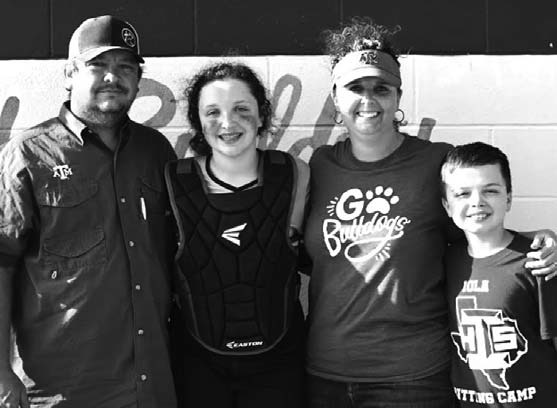
When he’s not working, Jurney is spending time with his family. He and his wife Christy have two children: Jenna, 15 and Ryan, 12. “They’re both really active in 4H and sports and school,” he said. “Iola is a small school like Dublin, which I think is a really good thing. They have the ability to do a lot of different things.”
The family enjoys taking vacations together. “We like to go snow skiing when we can,” he said. “Right now my daughter plays club volleyball, so the last year or two, a lot of our vacations have been built around a volleyball tournament. Last year, we went to Philadelphia and Indianapolis.”
Jurney’s parents, Mike and Celinda Jurney, still live in Dublin. Jurney has a herd of Brangus cattle that he and his dad work on the side. “We produce some commercial bulls for some local people that are in Dublin,” he said.
Throughout his life, Jurney has drawn strength from his faith. “I was raised in a really strong Christian home,” he said. “Family and faith have probably been the biggest inspirations for me.”
Jurney’s advice to Dublin graduates is to focus their careers on what they enjoy. “Find something you like to do, that you’re passionate about, and pursue that,” he said. “The hard days are a lot easier if you like what you’re doing.”
Editor’s Note: This column chronicles what Dublin graduates have done since high school. If you have any suggestions for other grads, email publisher@dublincitizen.com.