
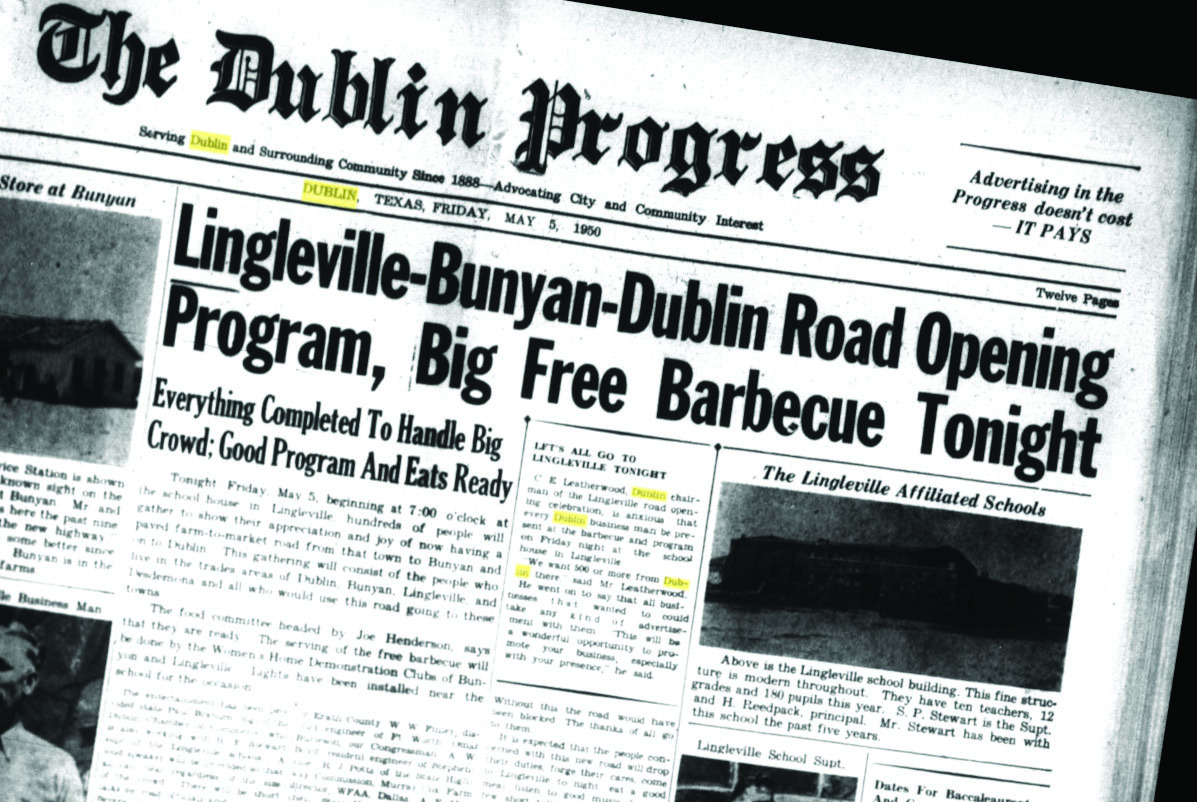
When I was young, my father told me about how the farm to market roads were dirt when he first came to Dublin. It was after World War II that Texas started paving rural roads such as FM 219.
There was a connection between Lingleville and Dublin. The Leatherwood family had a boarding house in Lingleville and their son, Clarence Leatherwood drove a freight wagon to Dublin to deliver cotton and freight and pick up grocery staples for friends in Lingleville. When it rained the wagon ruts would get deep and the trip would take much longer. In 1917 Leatherwood went to work at the Lingleville bank. In 1918 he started work at the Dublin National Bank. His warm friendship made him a prominent banker and city father. With his help, the people in Lingleville always felt welcomed when they came to Dublin to shop. (Dublin Shamrock, June 13, 1977) When the State of Texas started paving farm to market roads with asphalt, the Dublin city fathers and business men decided the road to Bunyan and on to Lingleville should be the first.
Those who lived along the route donated the right of way. They also complied the large amount of information necessary for state approval. Those citizens made trips to the State Highway Commission and were the leaders in its promotion assisted by the citizens from Dublin.
After a significant amount of time and effort the 12.1 mile project was finished.
It was at 7:00 pm, May 5, 1950 that a big celebration was planned. The road from Dublin to Lingleville was complete and the business men in Dublin put together a big celebration. “This is expected to be one of the biggest celebrations that has been held in this section in years.” “The celebration is to feature entertainment, good eats and fellowship.” (Dublin Progress, April 21, 1950) “This big occasion is for the people of Dublin, Bunyan, Lingleville, Desdemona and the surrounding rural trade territory.” Everyone was going to benefit from the Dublin, Bunyan, Lingleville farm-to-market road. (Dublin Progress, April 21, 1950) C. E. Leatherwood said “We want 500 or more from Dublin there.” “He went on to say that all businesses that wanted to, could take any kind of advertisement with them. This will be a wonderful opportunity to promote your business, especially with your presence” Earnest Hickey who had been operating a store in Lingleville since 1942 was the master of ceremonies. He was a civic leader and an outstanding citizen of Lingleville.
The Dublin High School band provided music and a quartet from Dublin sang with piano by Ben Robbins. Murray Cox of WFAA Radio was invited along with Erath County Commissioners, “The securing of this road is unique in the fact that the biggest effort in securing it came from the people who live along its route.” Others attending were S. P. Stewart, superintendent of Lingleville schools, E. Doper who operated the barber shop for 70 years and A. R. Crank who lived his entire life there. (Dublin Progress, May 5, 1950) The road is still a connection between like minded people who love the land and